
A non-standard aluminum grade can push your sheet metal delivery from two weeks to eight. A custom thickness tolerance can add another week. A mill certificate requirement can stall production while paperwork clears. Each of these is a “special material requirement,” and each one extends your lead time through a different mechanism.
If you are specifying materials for custom sheet metal parts, understanding what makes a requirement “special” — and why that matters for procurement — is the first step to accurate project planning.
What Counts as a Special Material Requirement?
A special material requirement is any material specification that falls outside what a fabricator typically stocks or can source through standard distribution channels. It is not simply “specifying a material.” It is specifying a material variant that requires additional procurement effort, documentation, or verification.
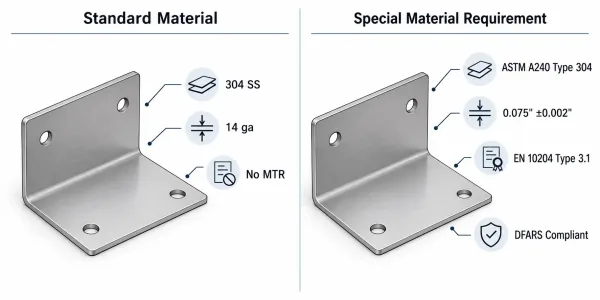
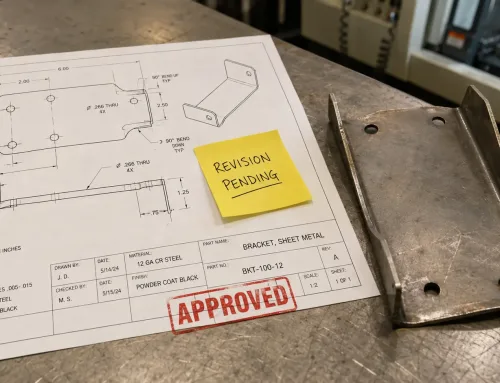
This diagram compares standard material specifications (common grades, standard gauges) with special material requirements (non-standard grades, custom thicknesses, certifications).
The distinction matters. Specifying 304 stainless steel in a standard gauge is a routine material callout. Specifying 304 stainless steel with a specific ASTM A240 mill certification, a custom 0.075″ thickness with ±0.002″ tolerance, and a DFARS compliance statement transforms the same material into a special requirement.
Non-Standard Grades and Alloys
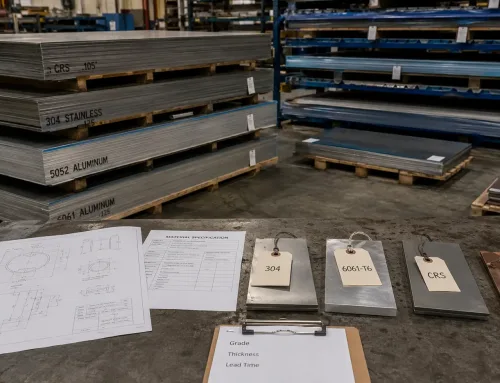
Standard grades are those your fabricator stocks in common gauges — 304 and 316 stainless steel, 5052 and 6061 aluminum, A36 mild steel. Non-standard grades include specialty alloys like Inconel, Hastelloy, Monel, titanium alloys (Ti-6Al-4V), and less common stainless grades such as 17-4 PH or 2205 duplex. These materials have smaller supplier pools and longer mill lead times.
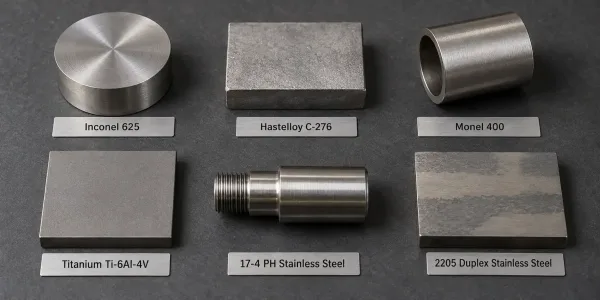
This image displays various non-standard specialty alloy samples commonly used in sheet metal fabrication, showing the visual differences between materials.
Even within common alloy families, non-standard designations count. Requesting 304L instead of 304, or 6061-T651 instead of 6061-T6, introduces sourcing variables that affect procurement timelines.
Custom Thicknesses and Tolerances
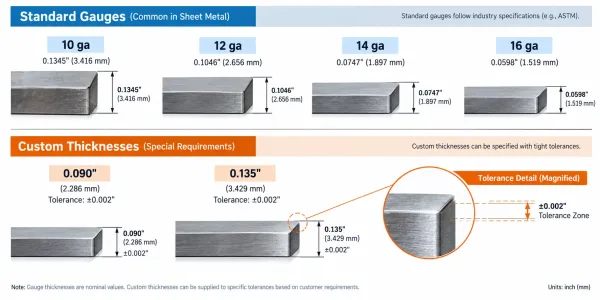
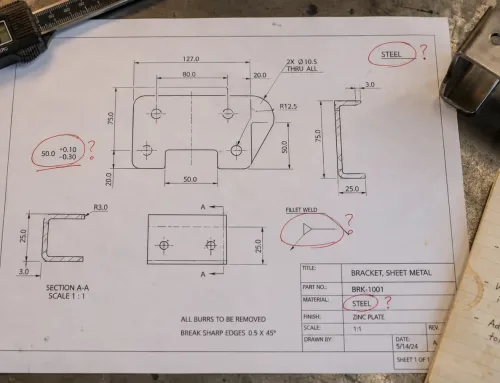
This diagram illustrates the difference between standard gauge thicknesses and custom thickness requirements, with tolerance specifications highlighted.
Sheet metal stock comes in standard gauge increments — 10 ga, 12 ga, 14 ga, 16 ga, and so on. When you specify a thickness that does not match a standard gauge, such as 0.090″ or 0.135″, you are requesting custom-rolled or precision-slit material. These require special mill orders or secondary processing, both of which extend lead times.
Tighter-than-standard thickness tolerances compound the issue. Standard commercial tolerances for sheet steel are defined by ASTM A568 or EN 10051. When your drawing calls for ±0.002″ instead of the standard ±0.005″, the material may need to be ordered from a precision mill or sorted from standard stock — either approach adds time.
Specific Tempers and Conditions
Aluminum tempers (T0, T3, T4, T6, T651) and steel conditions (annealed, normalized, hardened, tempered) affect both material availability and processing requirements. While T6 aluminum is widely stocked, T3 or T4 tempers are less common and may require mill orders.
For steel, specifying a particular hardness range — such as HRC 28-32 for 4140 — narrows the supplier field. Heat-treated material requires additional processing steps and certification, each adding days or weeks to procurement.
Certification and Compliance Requirements
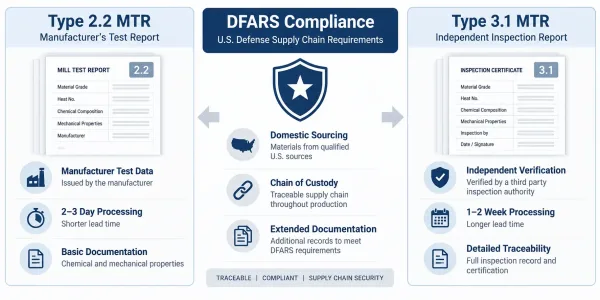
This diagram compares different certification document types, highlighting the differences between Type 2.2 and Type 3.1 mill test reports.
Certification requirements are among the most overlooked drivers of lead time extension. A mill test report (MTR) per EN 10204 Type 3.1 adds processing time at the mill. DFARS compliance restricts sourcing to domestic or approved foreign mills. NADCAP accreditation narrows the supplier pool further.
These requirements do not change the material itself — they change how the material must be sourced, documented, and verified. A 304 stainless steel sheet with a standard MTR may be available in three days. The same sheet with a Type 3.1 certificate and DFARS compliance statement may take three weeks.
Why Special Material Requirements Extend Lead Times
Special material requirements extend lead times through four primary mechanisms: limited supplier availability, minimum order quantities, certification processing, and inspection requirements. Each mechanism adds time independently; combined, they can multiply your procurement timeline.
Understanding these mechanisms helps you evaluate trade-offs early in the design process — when changes are still inexpensive.
Limited Supplier Pool for Specialty Materials
Standard materials have extensive distribution networks. A fabricator can source 304 stainless steel in standard gauges from dozens of metal service centers, often with same-day or next-day availability.
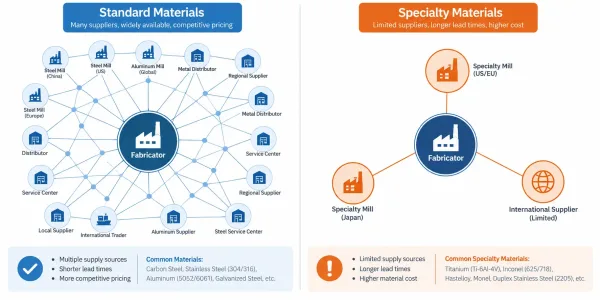
This diagram illustrates the difference in supplier availability between standard materials with many suppliers and specialty materials with limited sourcing options.
Specialty materials have narrower supply chains. Inconel, titanium, and specialty stainless grades may be available from only two or three domestic distributors, or may need to be sourced directly from a mill. International sourcing adds customs and logistics time. When a material has fewer suppliers, each supplier has more leverage on lead time — and fewer alternatives exist when one supplier cannot deliver.
Minimum Order Quantities and Mill Lead Times
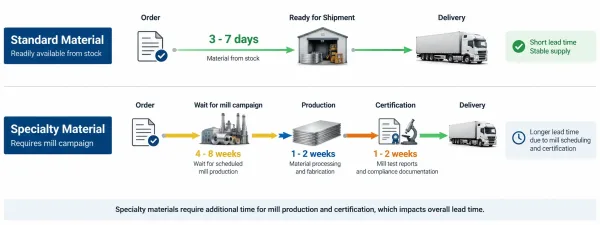
This timeline illustrates how mill production campaigns and minimum order quantities create extended lead times for specialty materials.
Mills produce specialty materials in campaigns, not continuous runs. A mill may not roll a particular alloy or thickness until a minimum order quantity is reached — often several thousand pounds. If your order is smaller than the mill’s minimum, your material waits until a production campaign is scheduled.
This “wait for mill run” is one of the most common causes of extended lead times for specialty materials. A standard steel sheet may be available from distributor stock in days. A custom-rolled specialty alloy may wait four to eight weeks for a mill run.
Certification and Documentation Processing
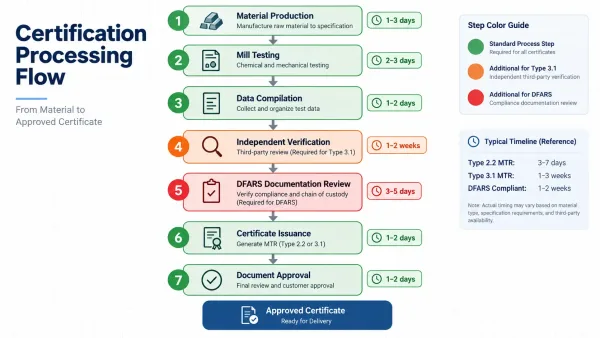
This flowchart shows the sequential steps in certification processing, from material testing through document compilation and issuance.
Mill certifications require time at multiple stages. The mill must test the material, compile the data, and issue the certificate. If you require EN 10204 Type 3.1 certification, the mill must perform independent verification testing. DFARS compliance requires documented chain of custody from melt to finished product.
Each certification layer adds processing time. A standard mill test report (Type 2.2) may add two to three days. A Type 3.1 certificate may add one to two weeks. DFARS compliance documentation may add another week for mills that do not routinely track this information.
Inspection and Testing Requirements
Special material requirements often include inspection protocols — chemical analysis verification, mechanical testing, ultrasonic inspection, or dimensional verification of thickness tolerances. These tests require time, equipment, and sometimes third-party laboratory involvement.
When inspection requirements are specified on the purchase order, the material cannot ship until inspection is complete and documentation is approved. This inspection cycle can add two to five business days to the procurement timeline, and longer if third-party testing is required.
Typical Lead Time Extensions for Special Requirements
Lead time extensions vary by requirement type and material. The following ranges reflect typical scenarios for sheet metal fabrication in North American markets.
Standard vs. Special Material Lead Times
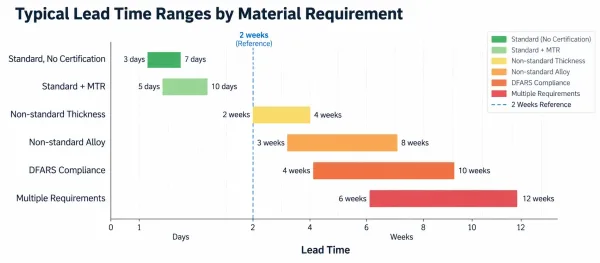
This bar chart visualizes the typical lead time ranges for different material requirement types, from standard materials to complex special requirements.
| Requirement Type | Typical Lead Time | Extension Over Standard |
|---|---|---|
| Standard grade, standard gauge, no certification | 3-7 business days | Baseline |
| Standard grade, standard gauge, MTR required | 5-10 business days | +2-3 days |
| Non-standard thickness or tolerance | 2-4 weeks | +1-3 weeks |
| Non-standard alloy or grade | 3-8 weeks | +2-7 weeks |
| DFARS or specialty compliance | 4-10 weeks | +3-9 weeks |
| Combination of multiple special requirements | 6-12 weeks | +5-11 weeks |
These ranges assume North American sourcing. International sourcing from Asian or European mills adds two to four weeks for shipping and customs.
Range of Extensions by Requirement Type
The extensions above are additive when requirements are combined. A non-standard alloy with DFARS compliance and tight tolerances may require 8-12 weeks — not because each requirement adds its maximum, but because they compound through the procurement chain.
Prototype quantities (under 100 pieces) typically experience longer per-unit lead times than production quantities, because small orders cannot justify dedicated mill campaigns. Production quantities (500+ pieces) may have shorter per-unit lead times but longer total procurement cycles due to the time required to schedule and execute mill runs.
How to Specify Special Material Requirements in RFQs
Clear specification at the RFQ stage is the most effective way to manage lead time expectations. Ambiguous or incomplete material requirements lead to clarification cycles that add days to the quoting process and weeks to the production schedule.
Key Information to Include in RFQs
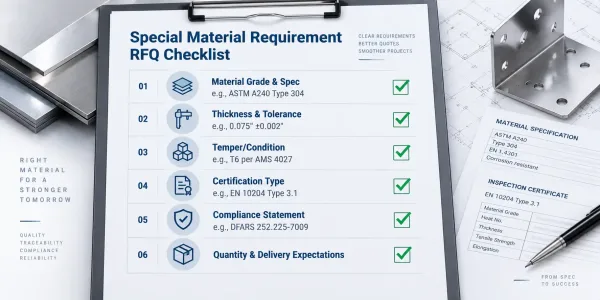
This checklist infographic summarizes the essential information buyers should include when specifying special material requirements in their RFQs.
When your material requirement includes any of the following, state it explicitly in your RFQ:
- Material grade and specification number (e.g., “ASTM A240 Type 304” not just “stainless steel”)
- Thickness and tolerance (e.g., “0.075” ±0.002″” not “14 ga”)
- Temper or condition (e.g., “T6 per AMS 4027” not just “aluminum”)
- Certification requirements (e.g., “EN 10204 Type 3.1 MTR required”)
- Compliance statements (e.g., “DFARS 252.225-7009 compliant”)
- Quantity and delivery expectations (to allow realistic scheduling)
The more complete your specification, the fewer clarification rounds your supplier needs — and the faster you receive an accurate quote with a realistic lead time.
Common Specification Pitfalls
Several specification patterns consistently cause delays:
Vague material callouts. “Stainless steel” without a grade, or “aluminum” without an alloy, forces the fabricator to ask for clarification. This adds one to three days to the quoting cycle.
Underspecified certifications. “Mill cert required” does not specify which type. Type 2.2 and Type 3.1 certificates have very different lead time implications. Specifying the exact certification type prevents misunderstandings.
Conflicting requirements. Specifying a material that cannot meet all stated requirements simultaneously — such as a temper that conflicts with a hardness range — creates confusion and requires engineering clarification.
Last-minute additions. Adding DFARS compliance or special certifications after the initial RFQ extends lead times because the fabricator must re-source material through compliant channels.
Evaluating Supply Risk for Special Requirements
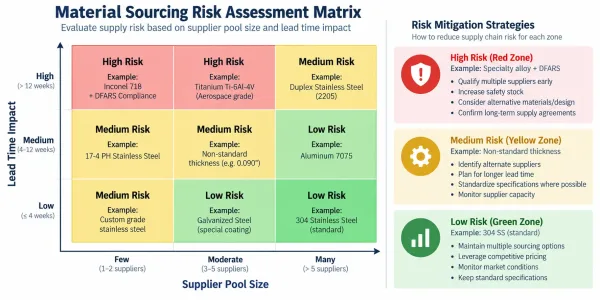
This risk assessment matrix helps buyers evaluate supply risk factors for special material requirements and identify appropriate mitigation strategies.
Not all special material requirements carry the same supply risk. Evaluating risk early helps you make informed decisions about material selection and project scheduling.
Supplier Capability Assessment
Before committing to a special material requirement, evaluate:
- Supplier pool size. How many domestic mills or distributors stock this material? Fewer than three suppliers indicates high supply risk.
- Mill schedule alignment. Does the mill have a scheduled production run for this material in the next 60-90 days? If not, your order may wait for the next campaign.
- Certification availability. Can your supplier provide the required certification type? Some mills do not offer Type 3.1 certificates for all products.
- Compliance documentation. For DFARS or other compliance requirements, does your supplier have documented chain of custody from melt to finished product?
Risk Mitigation Strategies
Several strategies can reduce supply risk for special material requirements:
Long-term agreements. If you anticipate ongoing need for a specialty material, a blanket purchase order or long-term agreement gives your supplier scheduling certainty and may secure priority allocation.
Dual sourcing. Qualifying two suppliers for the same material reduces single-point-of-failure risk. This is especially valuable for DFARS-compliant materials where supply chains are constrained.
Specification flexibility. Where possible, specify a range of acceptable materials rather than a single alloy. For example, “304 or 304L stainless steel” gives your supplier more sourcing options than “304 only.”
Advance planning. For project-critical materials, placing orders 8-12 weeks before production need dates provides buffer for mill scheduling and certification processing.
Strategies to Manage Special Material Lead Times
Special material requirements are sometimes unavoidable — the application demands a specific alloy, thickness, or certification. When that is the case, several strategies can help manage the extended lead time.
Early Engagement with Suppliers
The most effective strategy is early engagement. Contact your fabricator during the design phase, before drawings are finalized. A fabricator can advise on material availability, suggest alternatives that meet functional requirements with shorter lead times, and schedule material procurement to align with your production timeline.
Early engagement also allows the fabricator to place material orders before the formal RFQ, reducing the time between order placement and production start.
Alternative Material Considerations
When lead time is critical, evaluate whether a standard material can meet your functional requirements. Common substitutions include:
- 304L instead of 304 (slightly different chemistry, often more available)
- 5052-H32 instead of 6061-T6 (different strength, similar corrosion resistance)
- ASTM A1008 instead of A1011 (different steel grade, often interchangeable for non-structural applications)
These substitutions require engineering review to confirm functional equivalence. Your fabricator can advise on which substitutions are viable for your application.
Buffer Time Planning
For projects with fixed delivery dates, build procurement buffer into your schedule. A general guideline:
- Standard materials: Add 3-5 business days beyond quoted lead time
- Non-standard thicknesses: Add 1-2 weeks
- Non-standard alloys: Add 2-4 weeks
- DFARS or compliance materials: Add 3-6 weeks
This buffer accounts for sourcing delays, certification processing, and inspection cycles. It also provides margin for the unexpected — a mill delay, a shipping problem, or a last-minute specification change.
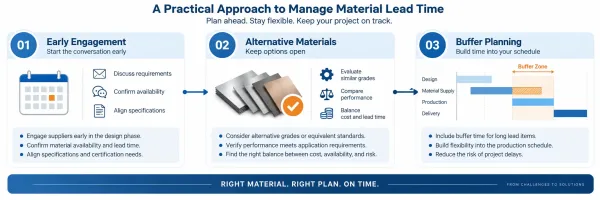
This infographic summarizes the three main strategies for managing extended lead times: early engagement, alternative materials, and buffer planning.