
You receive a quote from a sheet metal supplier. The document lists part numbers, quantities, unit prices, and—at the bottom—a total price. The number looks straightforward. But when you compare it against another supplier’s quote for the same parts, the totals do not match, and neither do the line items above them.
This is a common source of confusion in custom manufacturing procurement. The total price on a quote is not always calculated the same way by every supplier. Some quotes include tooling, surface treatment, and freight as separate line items. Others fold some of these costs into the unit price. Some quotes show a total that excludes tax; others include it. Understanding what the total price actually covers—and what it might not—is the first step toward accurate budgeting and reliable supplier comparison.
This glossary entry explains what total price means on a B2B manufacturing order, how it differs from unit price, what line items typically compose it, and how to review it before approving a purchase order.
What Total Price Means on a Manufacturing Quote
On a manufacturing quote, total price is the final amount the buyer is expected to pay for the complete order. It is the sum of all line items the supplier has included in the quotation—parts, services, and charges that apply to that specific purchase order.
This is different from the way the term is used in retail or e-commerce, where total price typically means item price multiplied by quantity plus sales tax. In custom manufacturing, the total price on a quote can include multiple cost categories beyond the parts themselves: tooling, surface finishing, inspection, packaging, and freight are common additions.
The total price is also context-dependent. A quote issued under EXW (Ex Works) terms will show a lower total than the same order quoted under DDP (Delivered Duty Paid), because the DDP total includes shipping and import duties. The quoted total price reflects what the supplier is charging—not necessarily everything the buyer will spend to get the parts into their facility.
Total Price vs. Unit Price: Where the Confusion Starts
Unit price and total price are related but not interchangeable.
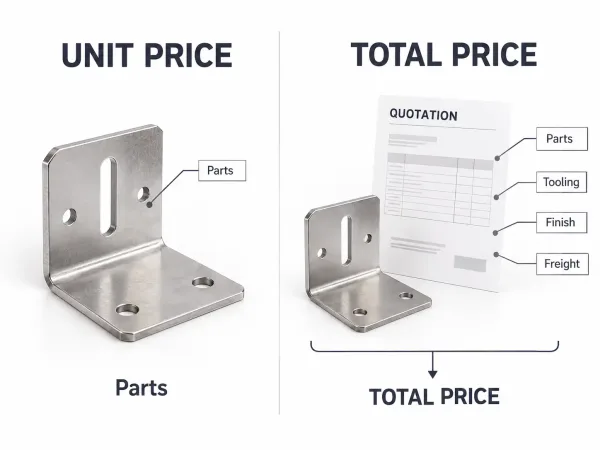
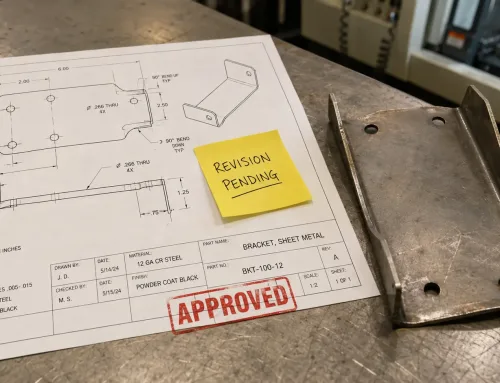
A comparison showing the difference between unit price and total price on a manufacturing order.
Unit price in manufacturing is the cost of a single part or assembly, as quoted by the supplier. It typically covers the manufacturing cost of one piece: material, processing, labor, and the supplier’s margin.
Total price is the order-level amount. At its simplest, it equals unit price multiplied by quantity. But in most manufacturing quotes, the total price includes additional line items that are not reflected in the unit price—or that are only partially reflected.
Consider a quote for 200 sheet metal brackets at a unit price of **8.50** each. The line item total for parts is ****1,700. But the quote also includes a one-time tooling charge of **400**, a powder coating line item of ****320, and a freight charge of **185**. The total price on this quote is ****2,605—not $1,700.
The mistake buyers sometimes make is comparing unit prices across suppliers without examining what each unit price includes. One supplier’s 8.50 unit price may already incorporate surface treatment. Another supplier's 7.20 unit price may exclude it, with surface treatment listed as a separate line item. The lower unit price does not necessarily produce a lower total price.
What Makes Up Total Price on a Sheet Metal Order
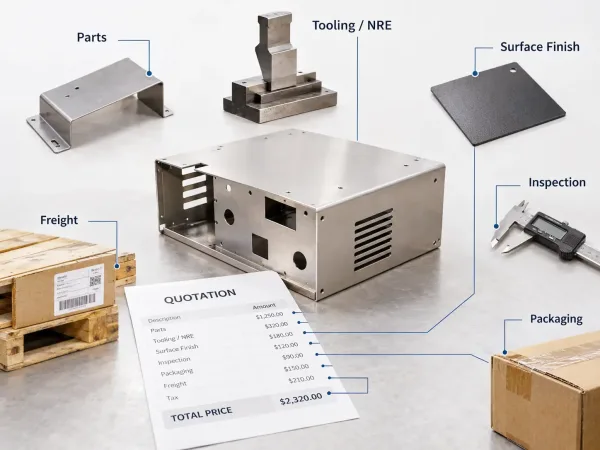
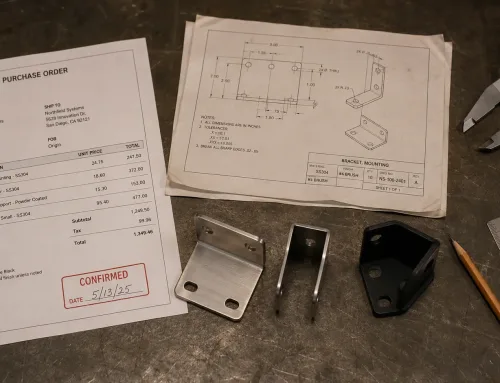
The main cost components that may contribute to the total price of a sheet metal manufacturing order.
A manufacturing quote can contain several line items that combine to form the total price. The exact composition varies by supplier, part complexity, and order requirements, but the following categories are the most common on a sheet metal fabrication quote:
Parts (unit price × quantity). This is the base manufacturing cost, calculated as the unit price multiplied by the number of pieces ordered. It covers material, laser cutting, bending, welding, deburring, and the supplier’s margin. This line item is present on every manufacturing quote.
Tooling and NRE (non-recurring engineering). Custom fixtures, forming dies, welding jigs, or programming time required for a new part are typically charged as one-time fees. On a first order, these charges can be significant—sometimes equal to or exceeding the cost of the parts themselves. On repeat orders, tooling charges usually disappear because the tooling already exists. Some suppliers amortize tooling across the first several orders rather than charging it as a lump sum.
Surface treatment. Powder coating, anodizing, plating, painting, or passivation are often quoted as separate line items, especially when the finish is specified by the buyer. Some suppliers include standard finishes in the unit price and charge extra only for non-standard requirements. Others list all surface treatment separately regardless of specification.
Inspection and quality documentation. When a buyer requests first article inspection reports (FAIR), material test reports (MTR), certificates of conformance (CoC), or third-party inspection, these services may appear as separate charges. Standard in-process inspection is usually included in the unit price.
Packaging. Standard export packaging—cardboard cartons, foam separators, palletizing—is often included in the quote. Custom packaging requirements—wooden crating, moisture barrier bags, individual part wrapping, retail-ready packaging—may be listed as additional charges.
Freight and shipping. Depending on the Incoterms, freight may be included in the quoted price (CIF, DDP) or listed as a separate line item (FOB, EXW). Even when freight is included, some quotes break it out as a visible line for transparency.
Tax. Sales tax, value-added tax (VAT), or goods and services tax (GST) may or may not be included in the quoted total. In international trade, tax treatment depends on the buyer’s location, the supplier’s tax jurisdiction, and whether the transaction qualifies for any exemptions. Domestic quotes may include or exclude tax depending on local practice.
Not every quote will contain all of these line items. A simple repeat order with no tooling, no surface treatment, and standard packaging may show only parts and freight. A first-time order with custom tooling, powder coating, and third-party inspection may show six or more line items.
How Incoterms Change What Total Price Covers
The Incoterm on a quote determines which costs are included in the supplier’s total price and which costs fall to the buyer. The same order can produce very different total prices depending on the quoted terms.
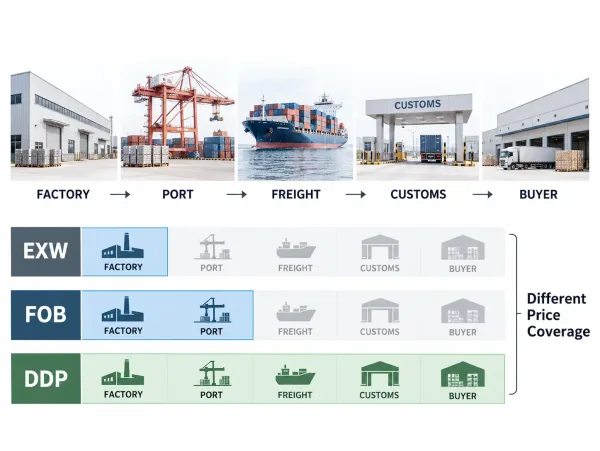
A simplified comparison of how EXW, FOB, and DDP Incoterms change the costs included in a manufacturing quote.
| Incoterm | What the quoted total price typically includes | What the buyer must arrange separately |
|---|---|---|
| EXW (Ex Works) | Parts at the supplier’s facility | Inland transport, export clearance, freight, insurance, import duties, destination charges |
| FOB (Free on Board) | Parts + inland transport to port + export clearance + loading onto vessel | Ocean/air freight, insurance, import duties, destination handling, inland delivery |
| DDP (Delivered Duty Paid) | Parts + all freight + insurance + import duties + destination delivery | Usually nothing—this is a landed price |
Under EXW terms, the quoted total price covers only the manufactured parts at the supplier’s facility. Everything else—pickup, freight, insurance, customs—is the buyer’s responsibility and cost. The buyer’s actual total cost will be significantly higher than the quoted total.
Under FOB terms, the quoted total includes the supplier’s costs up to the point where the goods are loaded onto the shipping vessel. Freight, insurance, and destination costs are the buyer’s responsibility.
Under DDP terms, the quoted total is intended to be the final price the buyer pays, with all logistics and duties included. DDP quotes are higher per line item but provide the most complete picture of total cost.
When comparing quotes from different suppliers, always verify that the Incoterms and shipping costs are based on the same scope. A quote at **12,000 FOB** and a quote at ****14,500 DDP may represent similar or even identical total costs to the buyer once freight and duties are added to the FOB quote.
Why Total Price Differs Between Prototypes and Production Runs
The total price for the same part can look very different depending on whether the order is a prototype run or a production run. The parts are identical—the cost structure is not.
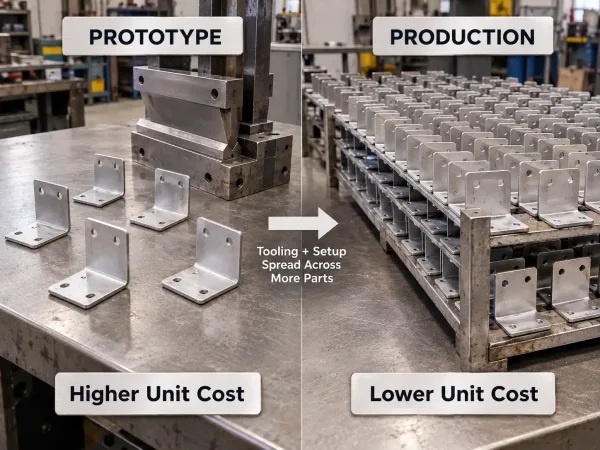
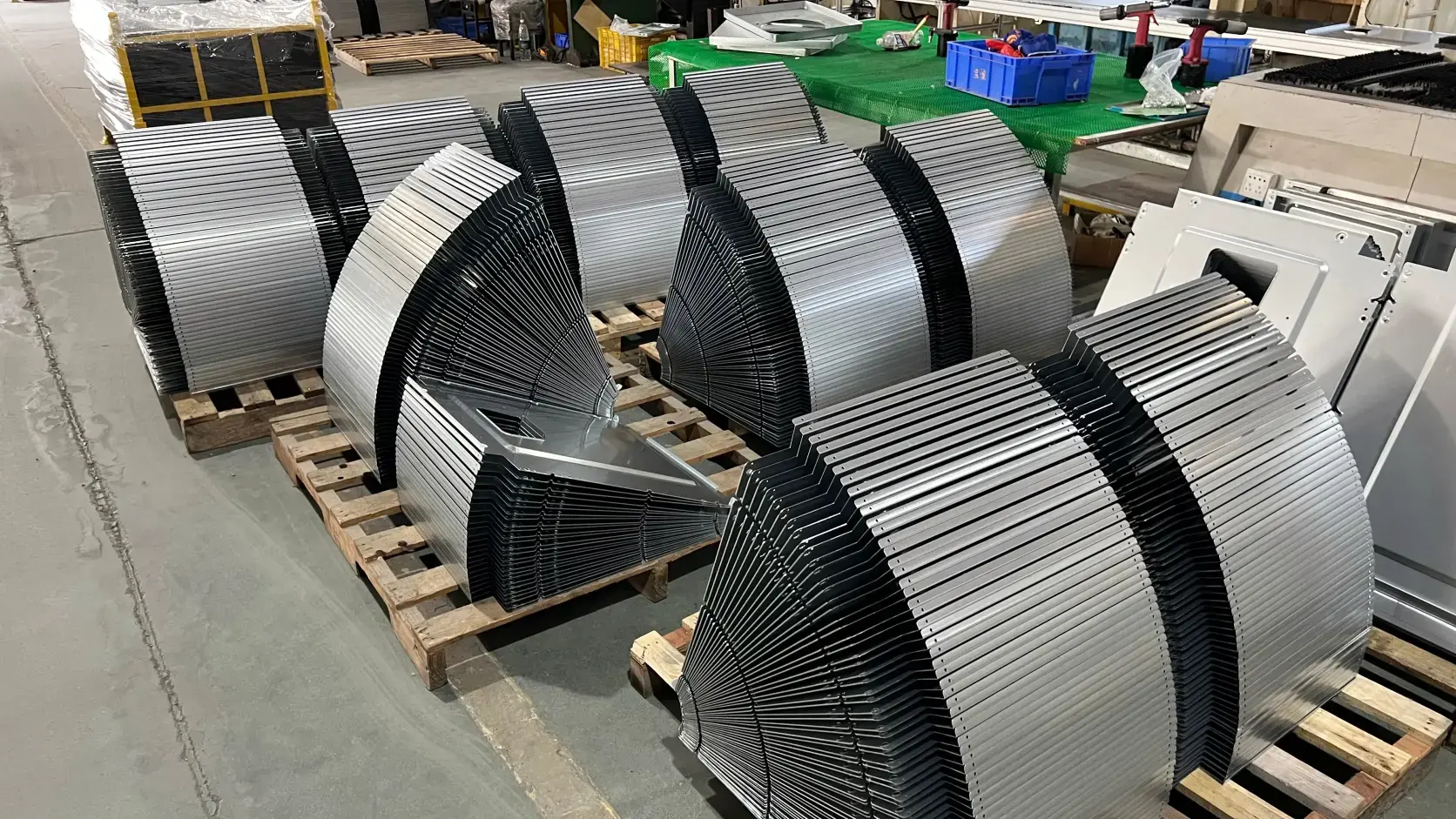
A comparison showing how prototype and production quantities create different manufacturing cost structures.
Prototype or sample orders (typically 1–20 pieces) often carry a high total price per unit because:
- Tooling and NRE are fully allocated. If a custom forming die costs
600 and the order is for 5 samples, the tooling adds120 per piece. On a production order of 500 pieces, the same tooling adds $1.20 per piece. - Surface treatment minimums apply. Many finishing houses have minimum batch charges. Powder coating 5 parts may cost as much as powder coating 50, because the setup and material waste are similar regardless of batch size.
- Setup time is not amortized. Laser cutting, bending, and welding all require machine setup. On a 5-piece order, setup time may equal or exceed the actual production time per piece.
- Packaging may be simplified or skipped. Sample parts are often hand-packaged without the protective measures required for international shipping.
Production orders (typically 50–5,000+ pieces) change the cost structure:
- Tooling per unit drops dramatically. NRE is amortized across a larger quantity.
- Surface treatment becomes more cost-effective. Larger batches fill coating tanks and curing ovens efficiently.
- Setup time per unit decreases. Machine setup is spread across more pieces.
- Additional line items may appear. Production orders are more likely to include inspection charges, custom packaging, and freight as visible line items—costs that were absorbed or waived on a small sample order.
The result is that a prototype order may show a total price of **1,800 for 10 pieces** (180 per unit), while a production order for 500 pieces of the same part shows a total price of **6,200** (12.40 per unit). The per-unit cost dropped by 93%, but the total order price increased because the production order includes more pieces and more line items.
Understanding this cost structure helps procurement teams set realistic expectations. A low prototype total does not guarantee a low production total—and vice versa.
How to Review Total Price on a Supplier Quote
Before approving a purchase order, verify the total price by checking the following items against the manufacturing quotation:
- Unit price × quantity = line item total for parts. Confirm the arithmetic. A transcription error in quantity or unit price will inflate or deflate the total.
- Tooling and NRE are listed separately. If the quote includes tooling, it should appear as its own line item with a clear description of what it covers (forming die, welding fixture, programming). If tooling is not listed, confirm whether it is included in the unit price or waived for this order.
- Surface treatment is accounted for. If your drawing calls for powder coating, anodizing, or any other finish, verify that the cost appears either as a separate line item or is confirmed as included in the unit price.
- Inspection and documentation charges are clear. If you require FAIR, MTR, CoC, or third-party inspection, confirm whether these are included or charged separately.
- Incoterms are stated and match your expectation. The quote should specify EXW, FOB, CIF, DDP, or another term. If no term is stated, ask—do not assume.
- Freight is realistic. If freight is listed as a line item, check that the shipping method (air, sea, express) and destination match your requirements. A quote that shows “freight included” without specifying the method may carry a placeholder estimate that will change at invoicing.
- Tax treatment is stated. Confirm whether the total includes or excludes sales tax, VAT, or GST. For international orders, confirm who is responsible for import duties and destination taxes.
- Quantity discounts are reflected. If you quoted multiple quantities, confirm that the unit price and total price correspond to the quantity you intend to order—not a different quantity option on the same quote.
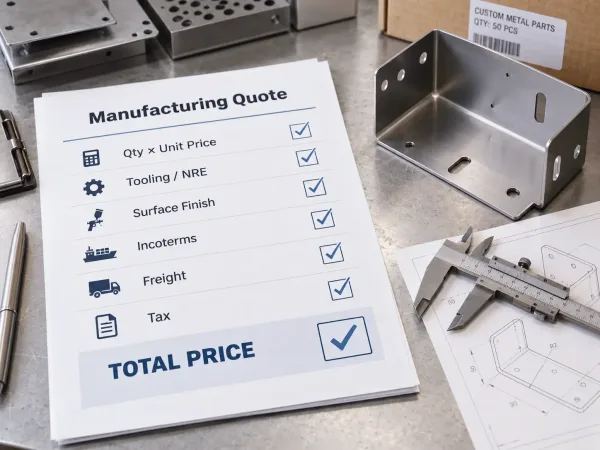
Key items to check before approving the total price on a manufacturing supplier quote.
If any line item is unclear or missing, request a revised quote with itemized costs before placing the order. A quote that shows only a lump-sum total without line item detail makes it impossible to compare against other suppliers or to identify where costs can be optimized.
FAQ
Confirm Your Total Price Before You Order
A clear, itemized total price is one of the simplest ways to avoid budget surprises and procurement disputes. If a quote arrives without line item detail—or if the Incoterms, surface treatment, or tooling charges are unclear—ask for clarification before placing the order.
Our engineering team reviews quotes and drawings as part of every DFM assessment, including a breakdown of cost components so you know exactly what you are paying for. If you would like a second set of eyes on your next quote, upload your drawings for a review →.