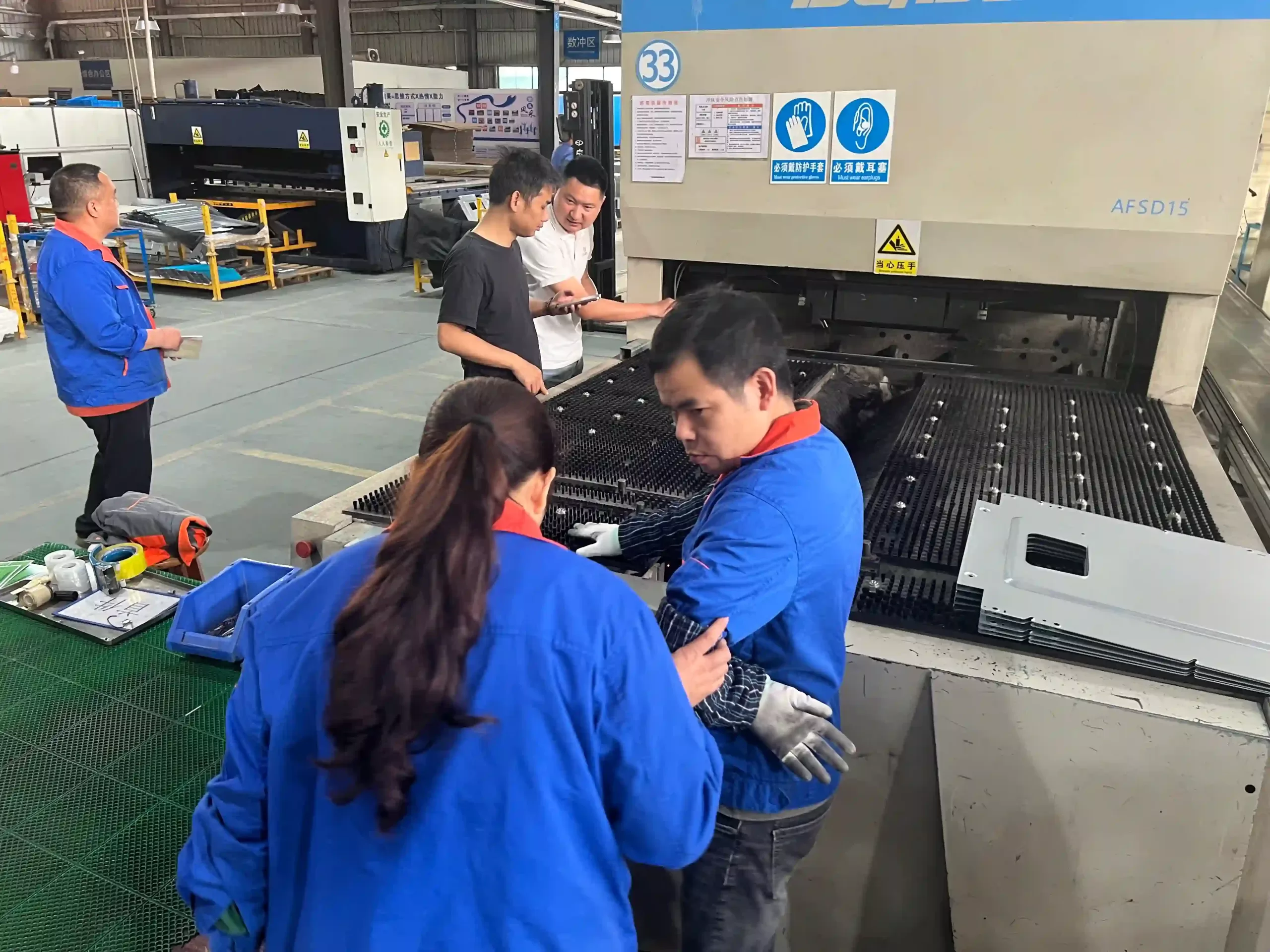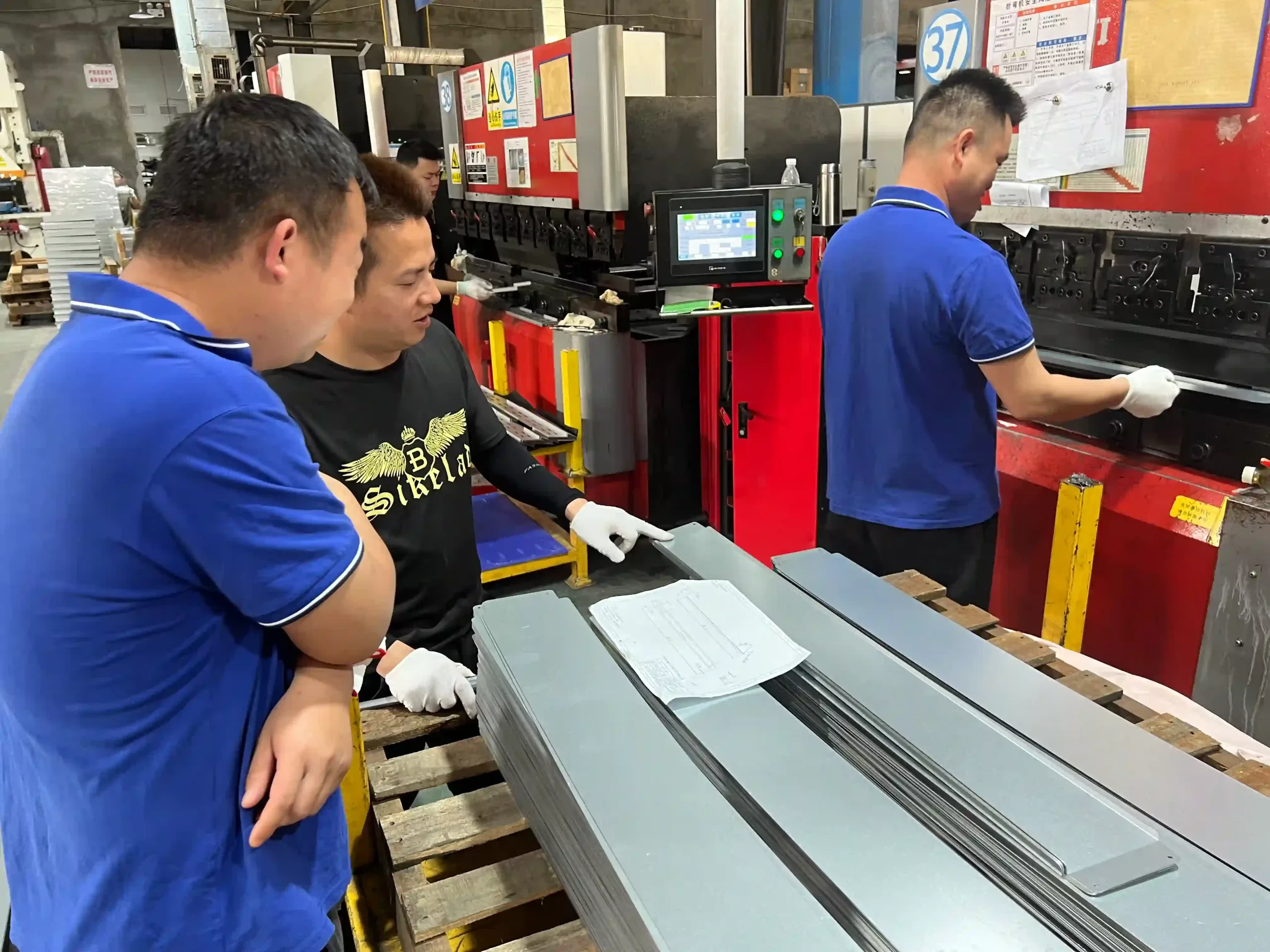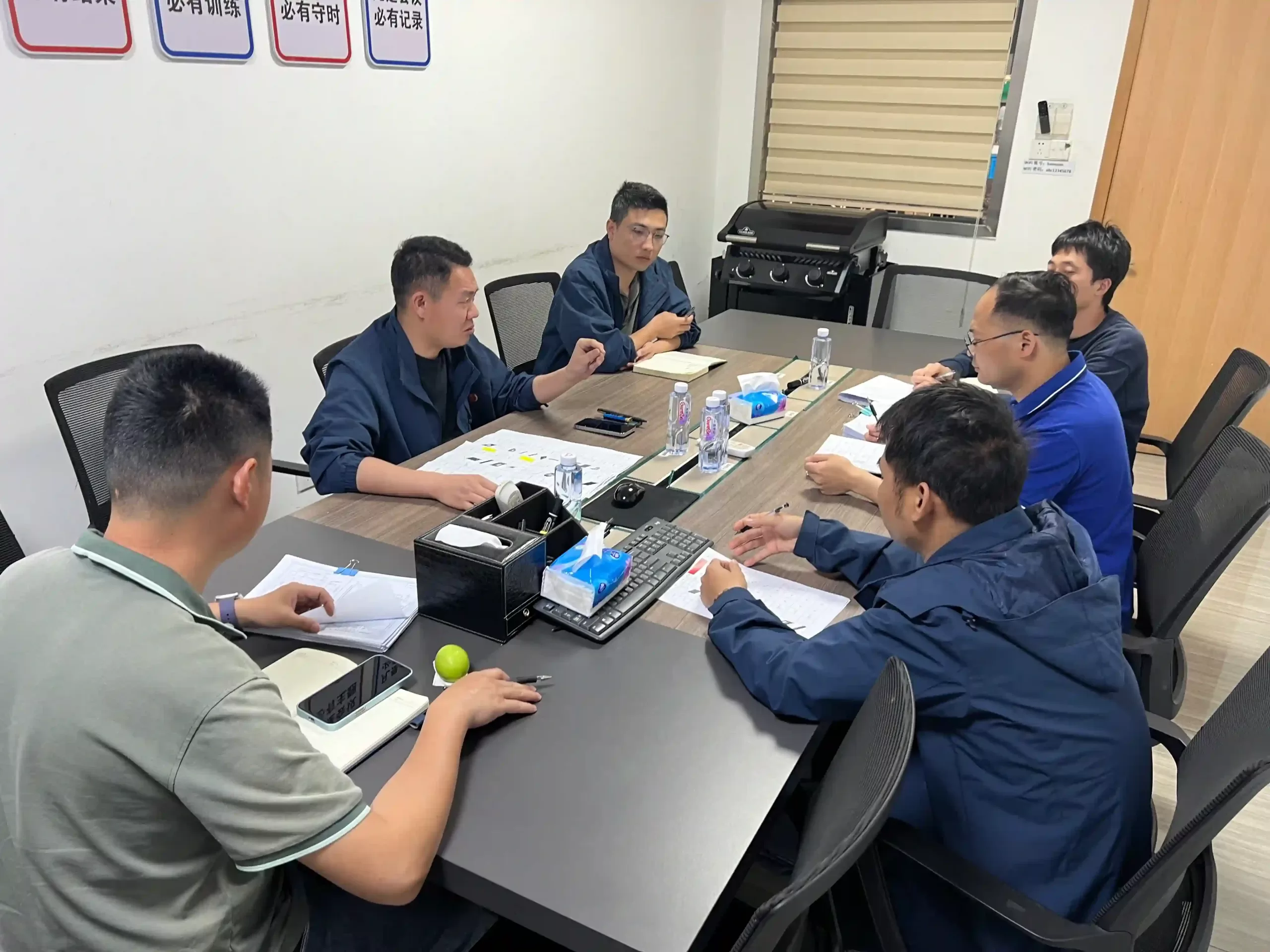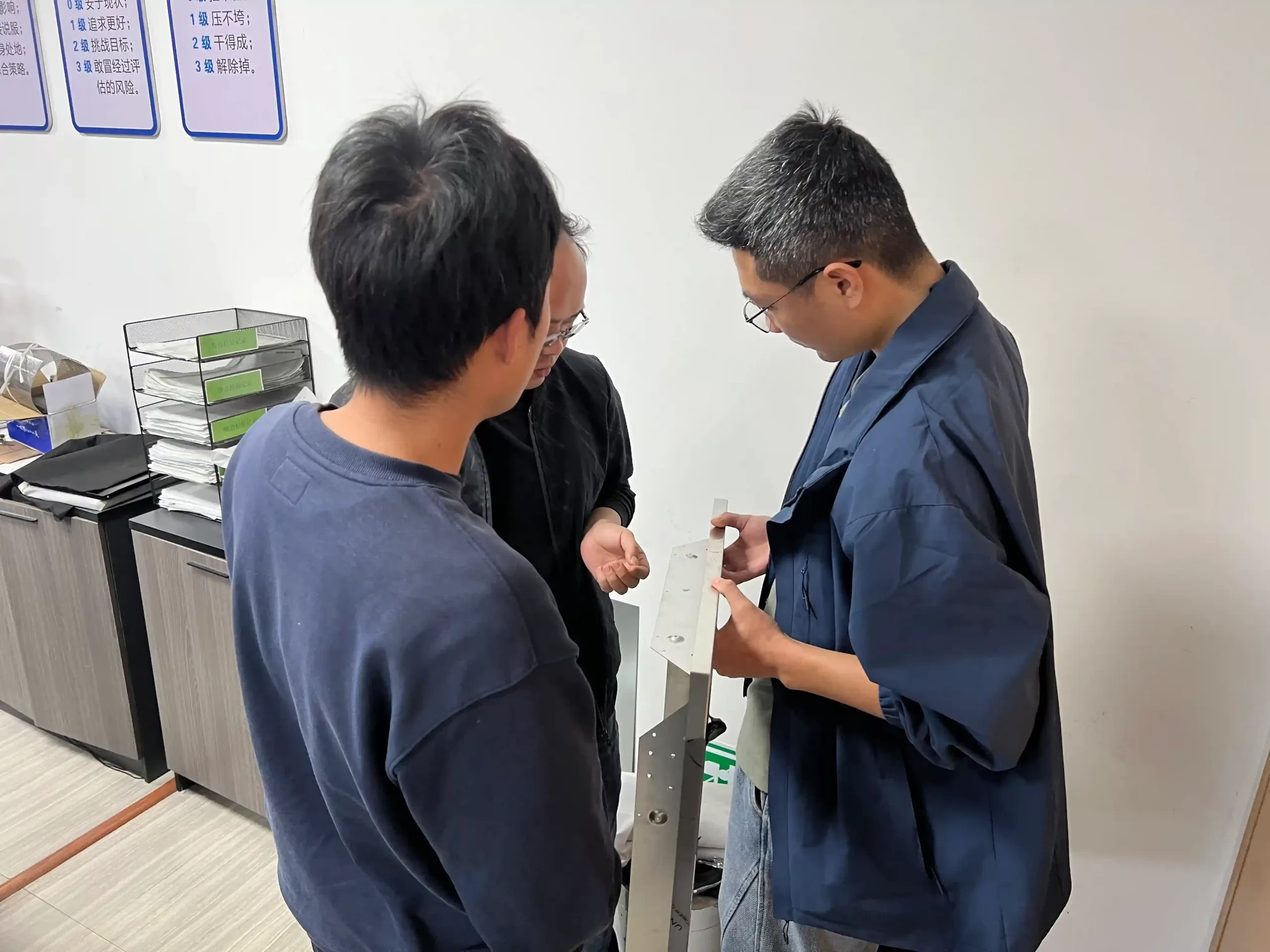
Sheet Metal Quality Control & Inspection
When evaluating a manufacturing supplier, most customers are ultimately asking the same questions: Can quality be maintained consistently? And is the delivery process fully traceable?At SR MFG, our quality control system is built on verifiable inspection procedures, traceable quality documentation, and process-wide quality control, giving you confidence in three key areas
-
We do more than just manufacture parts—we maintain consistent quality throughout production.
-
Our quality standards are not just claims; they are measurable, verifiable, and fully traceable.
-
From prototyping to mass production, we follow clear inspection procedures and defined delivery controls.
Make Quality Verifiable and Delivery More Reliable
Through incoming inspection, in-process control, final inspection, and supporting quality documentation, we help reduce project risks caused by dimensional variation, bending errors, surface defects, and batch-to-batch inconsistency. Based on our actual production data, our qualified yield rate reaches 98.5%, rework is kept below 1.5%, and batch consistency is controlled within ±0.1 mm.
- Full-process control from incoming material to final inspection: We have established four inspection checkpoints from raw material receiving to final shipment, so quality issues can be identified at the source or during production rather than reaching the customer.
- Multi-dimensional inspection covering dimensions, appearance, coating, and assembly: Each product goes through more than 15 key inspection items, covering dimensional accuracy, surface quality, coating performance, and functional verification.
- Quality documentation available, including FAI, dimensional reports, and material certificates: Depending on project requirements, we can provide more than 10 types of quality documents, including FAI reports, Certificates of Conformance (COC), material certificates, and dimensional inspection reports.
- Suitable for prototypes, low-volume runs, and mass production: Whether you need 3 prototype parts or a 10,000-piece production order, we apply the appropriate quality control plan to meet the requirements of each project stage.
Your Biggest Concerns
We understand that your biggest concern is usually not whether a supplier can make the part at all. If one supplier cannot do it, you can always find another. In Chinese manufacturing, there is a saying: “If one supplier can’t do it, plenty of others can.”
So the real issue is not whether the part can be made. The real issue is this: the sample passes, but problems appear once mass production begins. That is what truly causes frustration.
Based on our internal data, around 65% of quality issues occur during mass production, where material batch variation, machine parameter drift, and process deviation are much more likely to appear. At SR MFG, we address these risks through a systematic quality control approach designed to prevent problems at the source.
Dimensional Deviations That Lead to Assembly Problems
Dimensional variation is one of the most common quality issues in sheet metal fabrication, accounting for roughly 25% of all defects. Typical cases include holes that do not line up, bend dimensions that fall out of tolerance, or excessive assembly gaps that prevent proper fit and function.
At SR MFG, we control these risks in the following ways:
- Incoming material thickness inspection
Material thickness is checked upon receipt against applicable international standards such as EN 10131, ASTM A568/A568M, JIS G 3141, or customer drawing requirements, to prevent bend dimension errors caused by sheet thickness variation; - Bend angle compensation during forming
Based on material springback characteristics, we apply bend angle compensation of approximately 0.5° to 1.5° to keep the final bend angle deviation within ±0.5°; - 100% inspection of critical dimensions
Critical features such as mounting hole locations and assembly dimensions are inspected using calipers, height gauges, and CMMs to ensure compliance with drawing tolerances; - Dimensional inspection reports with actual measured values
Each batch can be supplied with a dimensional inspection report showing actual measurement data, rather than simply marking parts as “Pass.”
Unstable Bend Angles and Excessive Springback
Springback is an inherent characteristic of sheet metal fabrication. Different materials, thicknesses, and bend radii produce very different levels of springback. If compensation is not controlled accurately, bend angle deviations will accumulate.
Here is how we manage springback control:
- Material springback database
For commonly used materials such as SPCC, SUS304, and AL6061, we maintain a springback database covering different thicknesses and bend radii, with compensation accuracy controlled within ±0.3°. - First article verification of compensation values
Before each production run, the first article is checked to confirm that bend angles are within tolerance, and compensation parameters are fine-tuned based on actual results. - Dedicated angle measurement tools
We use digital angle gauges with an accuracy of ±0.1° and profile measurement equipment with an accuracy of ±0.01° to ensure accurate bend angle verification. - Ongoing bend angle stability monitoring
Bend angles are sampled every 50 pieces. If a deviation greater than 0.2° is found, production is stopped immediately for adjustment.
Welding Distortion or Poor Weld Appearance
The heat-affected zone created during welding can lead to sheet metal distortion and unattractive weld appearance. These are common customer complaints and account for approximately 15% of quality issues. Welding distortion can affect overall dimensions, while poor weld appearance can damage the visual quality of the product.
We control welding quality through the following measures:
- Standardized welding parameters
We develop standardized Welding Procedure Specifications (WPS) based on sheet thickness, material, and joint design, controlling current, voltage, and welding speed to reduce heat input. - Use of anti-distortion tooling
For welds prone to distortion, we apply preset counter-deformation, typically around 1.2 times the expected deformation, so the part returns to the correct shape after welding. - Post-weld stress relief
For higher-requirement parts, we perform stress-relief heat treatment after welding, typically at 300–350°C for 1–2 hours, to reduce residual stress. - Weld appearance grading inspection
Weld appearance is evaluated according to ISO 5817. For Grade B welds, undercut, porosity, and cracks are not acceptable.
Powder Coating or Painting Problems Such as Color Variation, Scratches, or Poor Adhesion
Surface finishing is the final step in sheet metal fabrication and serves as the product’s protective outer layer. It is also the stage where customers are most likely to notice defects. Color inconsistency, scratches, or poor coating adhesion can directly affect both appearance and protective performance.
We control surface finishing quality in the following ways:
- Standardized pretreatment process
Degreasing, rust removal, phosphating, or passivation are all tightly controlled to ensure the surface reaches the required cleanliness level, typically Sa2.5. - Real-time coating thickness monitoring
Coating thickness is checked during processing using coating thickness gauges to ensure powder coating thickness of 60–80 μm and liquid coating thickness of 40–60 μm. - Color difference testing
We use color meters to compare finished parts against approved color samples and keep color variation within ΔE ≤ 2.0 to meet appearance requirements. - Cross-hatch adhesion testing
The first article of each batch undergoes a cross-hatch adhesion test in accordance with GB/T 9286, with coating detachment limited to 5% or less, meeting ISO Class 1 requirements.
PEM Fasteners, Threads, or Hole Positions That Do Not Match
The accuracy of PEM nuts, threaded holes, and related features has a direct impact on assembly and future maintenance. Improper fastener installation, stripped threads, or hole position errors can all lead to assembly difficulty or fastening failure.
We control these risks as follows:
- Standardized insertion force for PEM hardware
For PEM hardware ranging from M3 to M12, we define standard insertion forces, typically 5–20 kN, to ensure secure installation without looseness. - 100% thread inspection with go/no-go gauges
Every threaded hole is checked using go and no-go gauges to ensure the go gauge passes fully and the no-go gauge does not, in accordance with GB/T 3934. - Post-installation perpendicularity check
The perpendicularity of installed hardware relative to the sheet surface is checked with angle measuring tools, with deviation controlled to ≤1° to prevent misaligned screw installation. - Mistake-proofing for directional hardware
For PEM hardware with directional requirements, we apply poka-yoke design features and clearly indicate installation direction on the drawing.
Samples Are Fine, but Mass Production Becomes Unstable
This may be the customer’s biggest concern of all. The sample passes inspection and everything looks fine—but once mass production starts, dimensional issues, appearance defects, and other problems begin to appear. In most cases, the root cause is that the sample was made under different conditions from the actual production run.
At SR MFG, we control this risk in the following ways:
- Prototype parts are made using production processes
During the sample stage, we use the same production equipment and process parameters intended for mass production, rather than relying on temporary hand-built or sample-only methods. - Pilot run validation
After sample approval, we carry out a pilot run of 10–50 pieces to verify process stability before full production begins. - Process capability analysis
We perform Cpk analysis on critical dimensions and require Cpk ≥ 1.33 to ensure sufficient process capability for mass production. - SPC control chart monitoring
Critical processes are monitored using SPC control charts so that abnormal trends can be detected and corrected early.
When Problems Happen, No One Can Find the Cause or Define Responsibility
Poor traceability is a common weakness among many suppliers. When a problem occurs, the root cause cannot be clearly identified, and responsibility becomes difficult to define.
Our approach is different:
- Batch traceability system
Every product is marked with a production batch number that can be traced back to the raw material batch, operator, equipment used, and inspection records. - Digital inspection records
All inspection data is entered into our MES system, stored permanently, and available for historical review at any time. - Closed-loop quality issue response
We operate a rapid-response quality system that provides root cause analysis within 8 hours and a corrective action plan within 24 hours. - Customer complaint case database
We maintain a database of customer complaint cases, conduct root cause analysis on recurring issues, and use those findings to prevent similar problems from happening again.
Our Quality Control Covers Every Critical Stage
Incoming Quality Control (IQC)
Incoming inspection is the first checkpoint in quality control. If issues can be identified and contained at the material stage, we can avoid unnecessary waste and losses in downstream production.
SR MFG Incoming Inspection Process:
Material grade verification → Sheet thickness verification → Surface condition inspection → Incoming quantity verification → Material certificate review
Inspection frequency:
Each incoming batch is inspected by sampling in accordance with GB/T 2828.1 or the customer’s specified standard, using normal inspection, single sampling, General Inspection Level II, AQL = 0.65.
Nonconforming material handling:
Any nonconforming material is immediately isolated, tagged with a red “Rejected” label, and recorded on a Nonconforming Material Report. The supplier is then notified for replacement or return, preventing unsuitable material from entering production.
In-Process Quality Control (IPQC)
In-process inspection runs throughout the entire manufacturing cycle. It is not about relying on final inspection to sort out defective parts at the end, but about preventing problems continuously during production. Our in-process control combines first article inspection, routine patrol inspection, and sampling inspection to maintain process stability.
SR MFG Incoming Inspection Process:
Material grade verification → Sheet thickness verification → Surface condition inspection → Incoming quantity verification → Material certificate review
Inspection frequency:
Each incoming batch is inspected by sampling in accordance with GB/T 2828.1 or the customer’s specified standard, using normal inspection, single sampling, General Inspection Level II, AQL = 0.65.
Nonconforming material handling:
Any nonconforming material is immediately isolated, tagged with a red “Rejected” label, and recorded on a Nonconforming Material Report. The supplier is then notified for replacement or return, preventing unsuitable material from entering production.
Final Inspection and Pre-Shipment Inspection
Final inspection is the last checkpoint before shipment. It ensures that every product delivered to the customer meets the required quality standard. Our final inspection combines 100% inspection for critical dimensions with sampling inspection for appearance and general quality characteristics.
SR MFG Final Inspection Process:
Critical dimension verification → Appearance inspection → Surface finish verification → Assembly-related feature verification → Quantity verification → Labeling, packaging, and protection inspection
Final Inspection Sampling Standards:
- Batch size ≤ 50 pcs: 100% inspection
- Batch size 51–500 pcs: Sampling inspection per GB/T 2828.1, General Inspection Level II, AQL CR=0, MA=0.65, MI=1.5
- Batch size > 500 pcs: Sampling inspection per GB/T 2828.1, General Inspection Level II, AQL CR=0, MA=0.4, MI=1.0
Inspection records:
A Final Product Inspection Report is completed for each batch, recording all inspection items, actual measured data, and inspection results. After review and sign-off, the records are archived for 5 years.
What Do We Focus on and Inspect During Production?
Dimensional Inspection
Dimensions are the most critical quality indicator in sheet metal fabrication. They directly determine whether a product can be assembled properly and perform as intended. Our dimensional inspection covers the following key items:
| Inspection Item | Inspection Tool | Typical Tolerance Requirement | Inspection Frequency |
|---|---|---|---|
| Overall dimensions | Vernier caliper (0.01 mm), tape measure | ±0.1 to ±0.3 mm | 100% |
| Hole diameter and hole position | Pin gauges, plug gauges, calipers | Hole diameter H12, hole position ±0.1 to ±0.15 mm | 100% |
| Bend angle | Digital angle gauge (±0.1°) | ±0.5° | 1 out of every 25 parts |
| Flange length | Vernier caliper | ±0.2 mm | 1 out of every 25 parts |
| Cutout and slot position | Profile projector, vision measuring system | Positional tolerance ≤ 0.15 mm | 1 out of every 25 parts |
| Critical assembly dimensions | CMM, inspection fixtures | ±0.05 to ±0.1 mm | 100% |
| Threaded holes and related features | Go / no-go thread gauges, thread gauges | Compliant with GB/T 3934 | 100% |
Appearance Inspection
Appearance is often the customer’s first impression of product quality, and it has a direct impact on customer satisfaction and brand perception. Our appearance inspection combines visual inspection, touch inspection, and magnified inspection to ensure the surface quality meets customer requirements.
| Defect Type | Inspection Method | Acceptance Criteria (Surface A / Surface B) | Typical Cause |
|---|---|---|---|
| Burrs | Touch inspection in the burr direction + 5x magnifier | Depth ≤ 0.1 mm / ≤ 0.2 mm | Deburring not completed after blanking or bending |
| Scratches | Visual inspection + strong directional lighting | Depth ≤ 0.05 mm / ≤ 0.1 mm, length ≤ 10 mm | Mechanical damage during handling or processing |
| Dents / pressure marks | Visual inspection + feeler gauge measurement | Diameter ≤ 2 mm, depth ≤ 0.1 mm | Excessive pressure from tooling or fixtures |
| Weld appearance | Visual inspection + weld gauge | No porosity, cracks, or undercut; weld bead must be uniform | Incorrect welding parameters |
| Surface contamination | Visual inspection + white cloth wipe test | No oil, dust, or fingerprints | Inadequate cleaning before finishing |
| Color variation | Color meter measurement | ΔE ≤ 2.0 (Surface A) / ΔE ≤ 3.0 (Surface B) | Uneven coating thickness or curing temperature fluctuation |
| Surface finishing defects such as orange peel or runs | Visual inspection at a 60° angle | Not acceptable on Surface A / slight defects acceptable on Surface B | Improper coating parameters or uneven solvent evaporation |
Functional Inspection
| Inspection Item | Inspection Method | Acceptance Criteria | Inspection Frequency |
|---|---|---|---|
| Hardware installation condition | Manual check + torque wrench | PEM hardware secure, fastening torque meets requirement | 100% |
| Thread go / no-go check | Go / no-go thread gauge | Go gauge passes fully, no-go gauge does not pass | 100% |
| Assembly fit | Trial assembly with actual mating parts | Smooth assembly, no interference, gap ≤ 0.3 mm | 1 out of every 50 parts |
| Go / no-go check | Inspection fixture, go / no-go gauge | Must meet drawing requirements | 100% |
| Assembly interchangeability | Any two parts from the same batch are swapped | Function remains normal after interchange, with no abnormality | 5 parts per batch |
| Hinge operation | Actual opening and closing test | Smooth movement, no binding, service life ≥ 10,000 cycles | First article validation |
| Sealing test | Air leak tester | No leakage | First article validation |
Surface Finish Inspection
| Inspection Item | Inspection Method | Acceptance Criteria | Inspection Frequency |
|---|---|---|---|
| Coating thickness | Coating thickness gauge (magnetic / eddy current) | Powder coating 60–80 μm, liquid coating 40–60 μm | 5 parts per batch, 5 points per part |
| Adhesion | Cross-hatch test (GB/T 9286) | 1 mm grid spacing, tape pull test, coating loss ≤ 5% | First article of each batch |
| Appearance uniformity | Visual inspection + gloss meter | No runs, orange peel, or pinholes; gloss variation ≤ 5 GU | 5 parts per batch |
| Hardness | Pencil hardness test (GB/T 6739) | ≥ H | First article of each batch |
| Impact resistance | Impact test (GB/T 1732) | 500 mm drop height, 500 g weight, no cracking | Once per week |
| Corrosion resistance | Salt spray test (GB/T 10125) | Neutral salt spray (NSS), no red rust after 500 hours | Once per quarter |
Our Inspection Capabilities and Commonly Used Measurement Tools
| Equipment Type | Measuring Range | Accuracy | Primary Use | Calibration Interval |
|---|---|---|---|---|
| Vernier caliper | 0–300 mm | ±0.02 mm | Measuring overall dimensions, hole spacing, and thickness | 12 months |
| Micrometer | 0–25 mm | ±0.001 mm | Sheet thickness measurement and precision dimension inspection | 12 months |
| Height gauge | 0–500 mm | ±0.01 mm | Height measurement and flatness inspection | 12 months |
| Angle gauge | 0–360° | ±0.1° | Bend angle and weld angle measurement | 12 months |
| Thread gauges / go-no-go gauges | M2–M12 | Compliant with GB/T 3934 | Threaded hole and hole diameter inspection | 6 months |
| Coating thickness gauge | 0–2000 μm | ±(1 μm + 1% of reading) | Coating thickness measurement | 6 months |
| Profile projector | 300 × 300 mm | ±0.005 mm | 2D dimension and contour measurement | 12 months |
| Coordinate measuring machine (CMM) | 1000 × 1000 × 800 mm | ±0.003 mm | 3D dimension and GD&T measurement | 12 months |
| Surface roughness tester | Ra 0.025–12.5 μm | ±5% | Surface roughness measurement | 12 months |
| Color meter | ΔE 0–100 | ΔE ≤ 0.1 | Color difference measurement | 6 months |
Inspection Capability Overview
- Standard dimensional inspection:
For routine dimensions such as overall size, hole spacing, and thickness, we use standard measuring tools including calipers, micrometers, and height gauges, with accuracy typically meeting ±0.01 to ±0.02 mm requirements. - Precision dimensional inspection:
For high-precision parts with tolerances of ≤ 0.05 mm, we use a CMM for measurement, with accuracy up to ±0.003 mm, ensuring reliable verification of critical dimensions. - GD&T inspection:
For flatness, perpendicularity, true position, and other geometric tolerances, we use a CMM or dedicated inspection fixtures to ensure compliance with drawing requirements. - Surface quality inspection:
For surface roughness, coating thickness, and color variation, we use specialized equipment such as surface roughness testers, coating thickness gauges, and color meters to ensure the required surface quality is achieved. - Third-party precision measurement support:
For projects with ultra-tight tolerance requirements of ≤ 0.01 mm, we can arrange third-party metrology support using advanced systems from brands such as Zeiss or Hexagon, with CNAS-certified inspection reports available upon request.
Available Quality Documents
| Document Name | Format | When Provided | Main Contents | Typical Use |
|---|---|---|---|---|
| Certificate of Conformance / Shipping Quality Declaration | PDF / hard copy | With every shipment | Batch number, quantity, inspection result, company stamp | Customer receiving inspection |
| Material Test Certificate (MTC) | PDF / hard copy | With every shipment | Material grade, chemical composition, mechanical properties, heat/lot number | Material traceability |
| Dimensional Inspection Report | Excel / PDF | With every shipment | Actual measured values of critical dimensions, tolerances, inspection results | Dimensional verification |
| First Article Inspection Report (FAI) | Excel / PDF | First article of a new product | Full inspection results for dimensions, appearance, and function | First article approval |
| Surface Finish Certificate | PDF / hard copy | With every shipment | Coating thickness, adhesion, salt spray test results | Coating validation |
| Pre-Shipment Packaging Photos | JPG / PDF | With every shipment | Packaging photos, label photos, protective measures | Packaging confirmation |
| In-Process Inspection Record | Available upon request | In-process inspection data, abnormality records | Process traceability | |
| Third-Party Test Report | Available upon request | Test data certified by CMA / CNAS-accredited labs | Special customer requirements | |
| Project Quality Plan | For new projects | Quality control flow, inspection standards, sampling plan | Project quality review | |
| Corrective and Preventive Action Report | When an issue occurs | Issue description, root cause analysis, corrective action, verification results | Customer complaint handling |
Traceability and Nonconformance Handling
Quality traceability is at the core of effective quality control. When a quality issue occurs, it allows us to quickly identify the root cause, determine responsibility, and take corrective action without delay.
Material batch traceability → Drawing revision control → Production record retention → Inspection record retention
Example of a Traceability Process
A customer reports that the hole diameter on a certain batch is undersized. The traceability system is then used to investigate:
How We Handle Nonconformances
Nonconformance handling is another essential part of the quality system. The goal is to ensure that once an issue is found, it is addressed quickly, corrected effectively, and prevented from happening again.
SR MFG Nonconformance Handling Process
Issue identified → Identification and segregation → Nonconformance report issued → Root cause analysis → Corrective and preventive actions defined → Implementation → Effectiveness verification → Record retention
Response Time for Nonconformance Handling
- Issue identified: immediately upon detection
- Root cause analysis: within 24 hours
- Corrective action plan: within 48 hours
- Implementation: carried out according to plan
- Effectiveness verification: within 7 days after implementation
Example of Nonconformance Handling
A batch of parts develops cracks after welding. The response process is as follows:
Quality You Can See