
When an OEM procurement team sends out an RFQ for a sheet metal enclosure, the quote that comes back usually has a line item for the parts, another for tooling or NRE, and sometimes a third for surface finishing.
What rarely shows up as a clearly labeled cost — until it does — is supplier quality documentation.
A buyer adds “PPAP required” to the purchase order after the quote is locked, and suddenly the supplier responds with a change order, a lead-time extension, or both.
This scenario plays out across fabrication shops every week. The root cause is not that suppliers charge too much for paperwork. It is that most buyers treat quality documentation as an afterthought instead of defining quality documentation requirements in the RFQ from the start.
This guide breaks down what supplier quality documents actually cost, what drives those costs up or down, and how to specify them properly so your project budget reflects the real number.
What Counts as Supplier Quality Documentation?
Supplier quality documentation is the set of records a fabrication supplier provides to prove that your parts were made to spec, from raw material through final inspection.
The term covers a range of document types, each serving a different verification purpose.
The documents most commonly required on OEM fabrication projects include:
- Certificate of Conformance (CoC) — A signed statement that the parts meet the specified requirements. The simplest form of quality documentation.
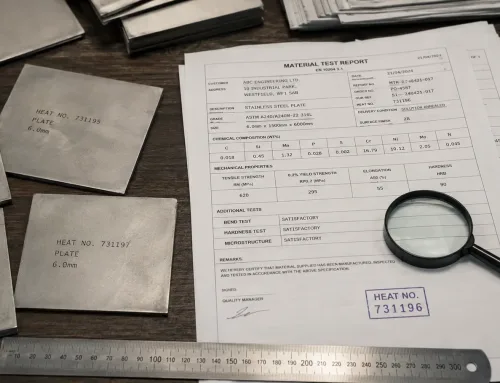
- Material Test Report (MTR) — Also called a mill certificate, this records the chemical composition and mechanical properties of the raw material, traceable to the heat lot. Governed by standards such as EN 10204 (3.1 or 3.2 certificates).
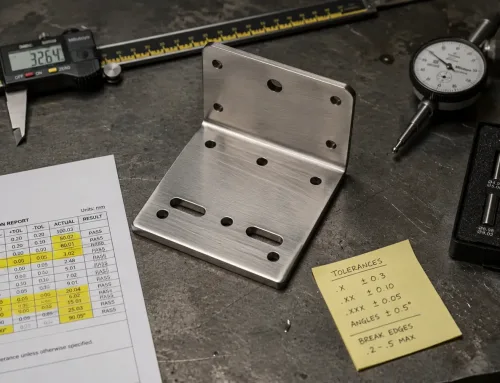
- First Article Inspection Report (FAI) — A dimensional report on the first production part, measured against the engineering drawing. AS9102 is the most widely referenced FAI standard.
- Production Part Approval Process (PPAP) — A comprehensive approval package originally developed for the automotive industry (AIAG standard). It includes dimensional results, material certifications, process flow diagrams, control plans, and customer sign-off.
- Inspection Report — Per-lot or per-shipment dimensional and visual inspection data, often with critical-to-function dimensions highlighted.
- Control Plan — A document describing how each manufacturing step will be monitored and what inspection methods will be used during production.
- Process Flow Diagram — A step-by-step map of the manufacturing sequence, from raw material receiving through final packaging.
Not every project requires all of these. The set you specify depends on your industry, your end-use application, and your internal quality requirements.
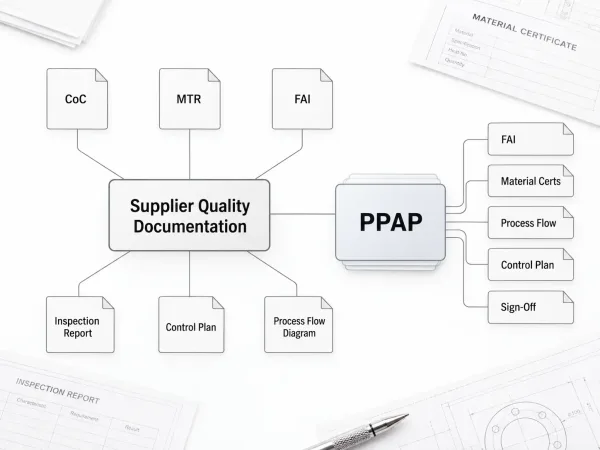
A structured diagram showing the main document types involved in supplier quality documentation.
But each document has a real cost to produce — and understanding that cost is the first step to controlling it.
What Each Document Type Typically Costs
Quality documents are not free filler. They require engineering time, measurement data, and sometimes third-party verification.
The cost varies widely by document complexity and the amount of shop-floor labor involved.
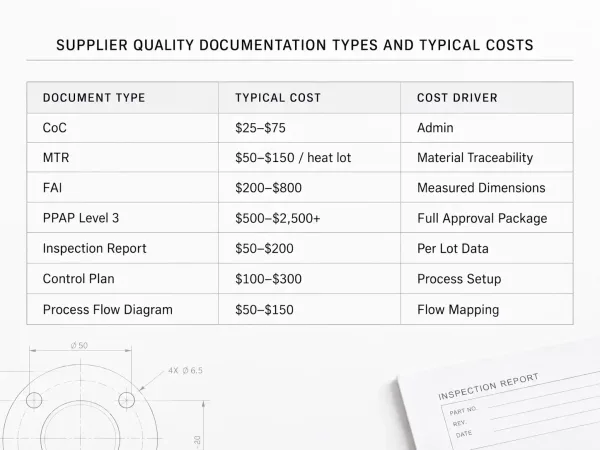
A comparison chart showing common supplier quality documents and their typical cost ranges.
The following ranges reflect typical costs charged by mid-size fabrication suppliers for a moderately complex sheet metal part (3–5 forming operations, welded assembly, powder coated):
| Document | Typical Cost Range | What Drives the Cost |
|---|---|---|
| Certificate of Conformance (CoC) | $25–$75 | Minimal — a signed form, usually included or charged as a flat admin fee |
| Material Test Report (MTR) | $50–$150 per heat lot | Depends on material type; stainless steel and specialty alloys cost more to certify than mild steel |
| First Article Inspection (FAI) | $200–$800 | Proportional to the number of dimensions measured; a simple bracket FAI may take 1 hour, a complex weldment FAI may take 4+ hours |
| PPAP (full Level 3) | $500–$2,500+ | Includes FAI + process flow + control plan + MSA studies + sample retention; the most labor-intensive package |
| Inspection Report (per lot) | $50–$200 | Depends on sample size and number of critical dimensions |
| Control Plan | $100–$300 | One-time creation cost; reusable across production runs if the process does not change |
| Process Flow Diagram | $50–$150 | One-time creation cost; lower than a control plan because it is less detailed |
These costs are typically quoted as one-time NRE costs (non-recurring engineering) at the RFQ stage.
On repeat orders, the supplier may waive some documents if the process is unchanged — or charge a reduced fee for updating existing records.
The key point: a CoC costs almost nothing, but a full PPAP package can add $500–$2,500 to your first order.
If you are ordering 50 parts at $30 each, that PPAP adds $10–$50 per unit in documentation cost alone.
At 5,000 parts, the per-unit impact drops to $0.10–$0.50.
Batch size changes the math significantly, which we will cover in a later section.
How Industry and Certification Level Change the Cost
The same sheet metal part ordered by a general industrial OEM and by an aerospace OEM will carry very different documentation requirements — and very different costs.
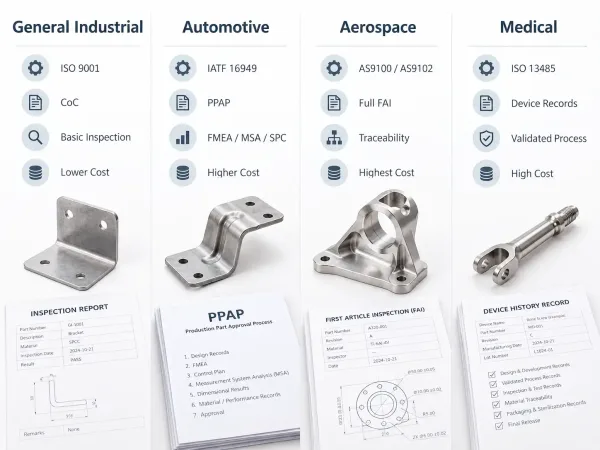
A comparison graphic showing how quality documentation requirements and cost levels vary by industry.
The gap is not just about more paperwork. It is about the depth of traceability, the rigor of measurement, and the frequency of verification.
General industrial (ISO 9001 baseline): Most fabrication suppliers holding ISO 9001 certification can provide a CoC and basic inspection report at little or no incremental cost. These documents are part of their standard quality system. If you need an MTR, expect a modest charge. FAI and PPAP are not typical requirements unless your internal procedures mandate them.
Automotive (IATF 16949): The automotive sector expects PPAP as standard, along with process FMEA (Failure Mode and Effects Analysis), MSA (Measurement Systems Analysis), and ongoing SPC (Statistical Process Control) data. The documentation package is significantly more comprehensive. Expect PPAP costs on the higher end of the range, and plan for recurring costs if you require periodic PPAP updates.
Aerospace (AS9100 / AS9102): Aerospace fabrication demands full FAI per AS9102, complete material traceability to the original mill heat, and often special process certifications (e.g., NADCAP for welding, heat treatment, or surface finishing). The documentation burden is the highest of any sector. A single FAI on a complex aerospace sheet metal part can cost $800–$1,500 because of the measurement density and traceability chain required.
Medical devices (ISO 13485): Medical device fabrication requires device history records, biocompatibility documentation for patient-contacting parts, and validated process records. The documentation cost is high, though the specific documents differ from automotive or aerospace.
The practical takeaway: if you are sourcing from a supplier accustomed to your industry’s documentation standards, the process is efficient and the cost is predictable.
If you are asking a general-industrial shop to produce aerospace-grade documentation, expect higher costs, longer lead times, and a learning curve on both sides.
Why Batch Size Changes the Math
Documentation costs are largely fixed per design, not per part.
An FAI report takes the same number of engineering hours whether you are ordering 50 parts or 5,000. A PPAP package is a one-time compilation regardless of production volume.
This means the per-unit documentation cost is inversely proportional to your order quantity:
| Order Quantity | PPAP Cost ($1,500 example) | Per-Unit Documentation Cost |
|---|---|---|
| 50 units | $1,500 | $30.00 |
| 250 units | $1,500 | $6.00 |
| 1,000 units | $1,500 | $1.50 |
| 5,000 units | $1,500 | $0.30 |
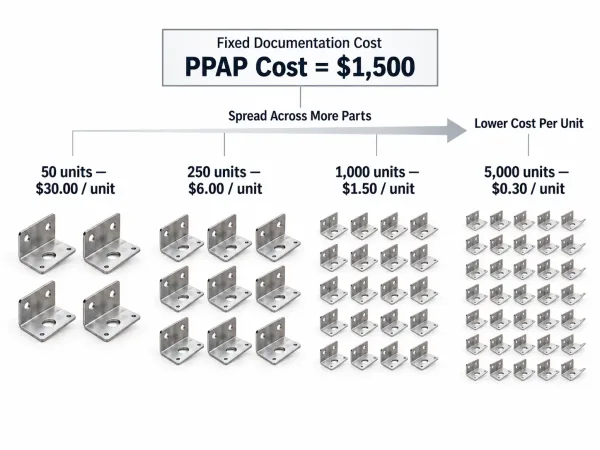
A visual comparison showing how fixed documentation cost is spread across larger order quantities.
For prototype and low-volume orders (under 100 units), documentation costs can represent 10–30% of the total part cost.
At production volumes, the same documentation becomes a rounding error.
This has a practical implication for procurement strategy: if you are in a prototyping or pilot phase, consider whether every document is truly needed at this stage.
Some OEMs defer PPAP until production release and accept a simpler FAI for prototype builds.
This does not eliminate the documentation cost — it defers it to the stage where higher volumes absorb it more efficiently.
How Documentation Requirements Shape Your RFQ Quote
When a fabrication supplier receives an RFQ that includes quality documentation requirements, those requirements affect the quote in several ways.
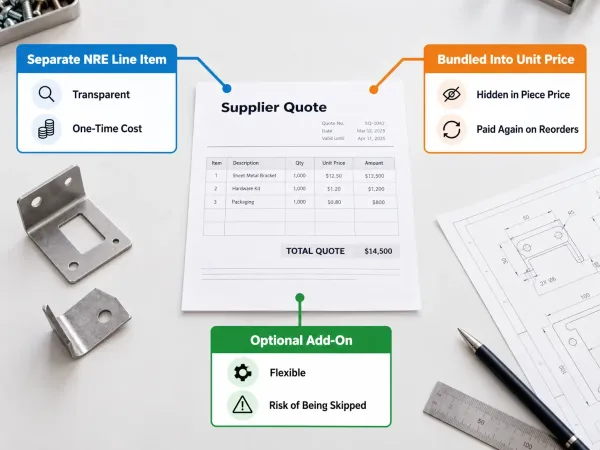
A visual diagram showing the main ways quality documentation appears in a fabrication quote.
As a separate NRE line item. This is the most transparent approach. The supplier lists documentation cost as a one-time charge, separate from per-unit pricing. Buyers can see exactly what they are paying for and compare across suppliers.
Bundled into per-unit pricing. Some suppliers embed documentation costs into the piece price, especially for recurring orders. This makes the quote look lower but obscures the true cost of the documentation. It also means you continue paying for documentation on every reorder, even after the initial records are created.
As an optional add-on. Some suppliers quote parts without documentation and offer quality packages as an option. This can be useful for buyers who are comparing suppliers on part cost alone — but it also creates a risk that critical documentation gets skipped to save money.
The most effective approach for OEM buyers is to define manufacturing quality requirements in the RFQ itself, including documentation with the same specificity used for material, tolerance, and finish.
A vague “provide quality docs” leaves room for interpretation and often results in either under-delivery (the supplier provides only a CoC when you expected PPAP) or over-charging (the supplier quotes a full PPAP when you only needed an FAI).
A Buyer’s Checklist: Specifying Documentation at the RFQ Stage
The following checklist helps procurement teams specify quality documentation requirements in a way that produces accurate quotes and avoids post-order surprises:
- List each required document by name. Do not say “quality package” — specify CoC, FAI, PPAP Level 3, MTR, inspection report, or whatever applies to your project.
- Reference the applicable standard. If you require FAI, state AS9102. If you need material certificates, state EN 10204 Type 3.1 or 3.2. Standards eliminate ambiguity.
- Define the inspection scope. Specify which dimensions are critical and must be measured. A supplier cannot price FAI accurately without knowing whether you need 15 dimensions checked or 150.
- State acceptance criteria. If a dimension has a tolerance of ±0.1 mm, say so on the drawing. If surface roughness must be Ra 1.6 μm or better, write it down. Unclear acceptance criteria lead to failed inspections and rework.
- Specify certificate format. Do you need original signatures or are digital copies acceptable? Do you need heat-lot traceability on every MTR, or is batch-level traceability sufficient?
- Clarify whether third-party verification is required. If your quality system requires independent lab testing (e.g., mechanical testing, chemical analysis) beyond the supplier’s in-house capabilities, this adds cost and lead time. State it upfront.
- Indicate whether documentation is required on first order only or on every shipment. Recurring inspection reports on every lot add cost. If your process allows skip-lot or periodic inspection, say so — it reduces the supplier’s recurring burden.
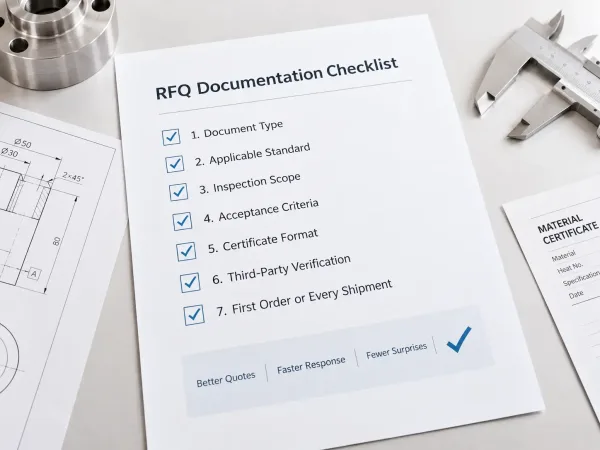
A practical RFQ checklist showing the key items buyers should define for supplier quality documentation.
A well-specified documentation requirement in an RFQ produces three outcomes: more accurate quotes, faster supplier responses, and fewer technical clarifications after the order is placed.
FAQ
Need help specifying quality documentation requirements for your next fabrication RFQ? SR-MFG’s engineering team can review your documentation requirements at the quoting stage and provide a clear cost breakdown — no surprises after the order is placed. Contact us to get started.