
When you are designing a metal enclosure — an electrical cabinet, a control box, an instrument housing — one of the first manufacturing decisions you face is how to join the corners. Two methods dominate sheet metal fabrication: welding the corners shut, or folding them from a single continuous sheet. The choice is not obvious. A welded corner provides maximum structural strength and sealing, but it introduces heat distortion, extra finishing steps, and higher per-part cost. A folded corner avoids heat entirely and speeds up production, but it has geometry limits and may not meet every sealing requirement. This guide breaks down the real differences between welded and folded corners so you can specify the right joint for your enclosure before the first quote comes back.
What Are Welded Corners?
A welded corner joint is created by fusing two adjoining sheet metal panels at their edges using a welding process — typically MIG (metal inert gas), TIG (tungsten inert gas), or spot welding. The weld bead melts the parent metal and often adds filler wire to form a permanent metallurgical bond between the two panels.
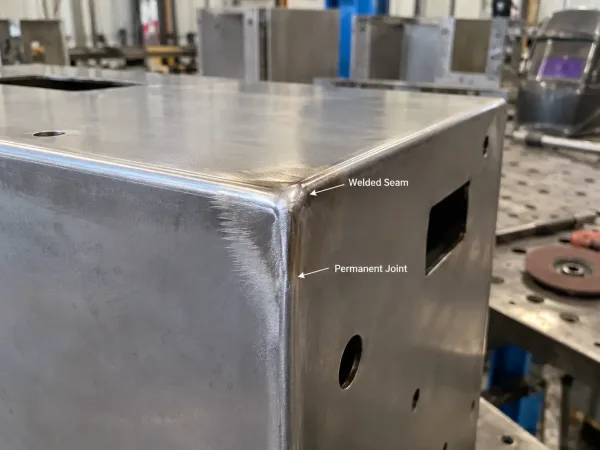
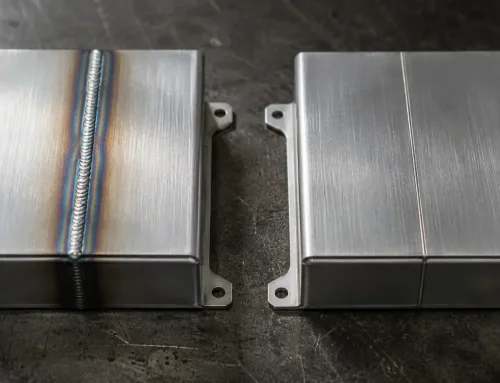
Close-up view of a welded enclosure corner showing the joined sheet metal panels and finished seam.
Welded corners are common in heavy-duty enclosures, outdoor cabinets, and any application where structural integrity and environmental sealing are critical. The continuous weld creates a barrier that resists water ingress, dust, and mechanical loads.
However, welding concentrates 3,000–5,000 °C of heat into a thin steel sheet. On enclosures made from 1.0–2.0 mm cold-rolled or galvanized steel, each welded corner can warp the surrounding panel by 0.3–0.8 mm. A typical enclosure has 6–10 corner joints, and the cumulative distortion can push a door frame 1–2 mm out of square — enough to prevent proper door seating or gasket compression. After welding, most enclosures require grinding to smooth the weld seam, followed by surface treatment such as painting or powder coating. The grinding step removes material locally and can thin the parent metal if not controlled carefully.
What Are Folded Corners?
A folded corner — also called a formed corner or bent corner — is created by bending a single sheet of metal along a scored or pre-cut line to form a 90° angle. The sheet remains continuous; no filler material is added and no heat is introduced.
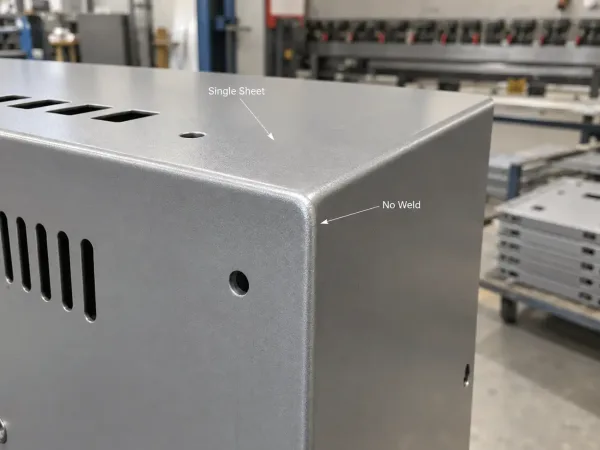
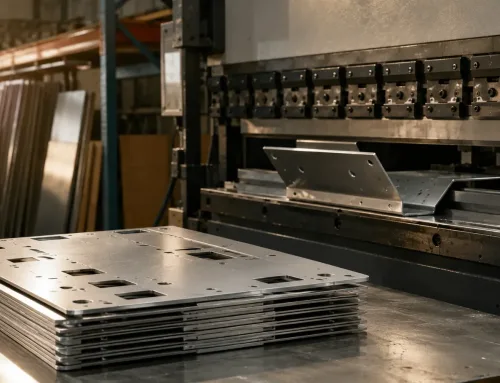
Close-up view of a folded enclosure corner formed from a single continuous sheet.
Folded corners are the standard approach for most commercial and industrial enclosures, including server racks, electrical panels, and instrument housings. The bend is typically made on a press brake, and the corner radius is determined by the tooling and material ductility. Because there is no welding, folded corners avoid heat distortion entirely. The panel stays flat, the coating remains intact, and the production cycle is significantly faster — a single operator can form all four corners of an enclosure in under 60 seconds with the right equipment.
The main limitation of folded corners is geometry. The bend radius is constrained by the material thickness and the press brake tooling. Sharp inside corners — below 0.5× the material thickness — are not achievable without cracking, especially on aluminum and stainless steel. For enclosures that require complex three-dimensional shapes or very tight corner radii, folding alone may not be sufficient.
Welded vs. Folded Corners: A Side-by-Side Comparison
The table below compares the two corner joint methods across the dimensions that matter most for enclosure design and procurement.
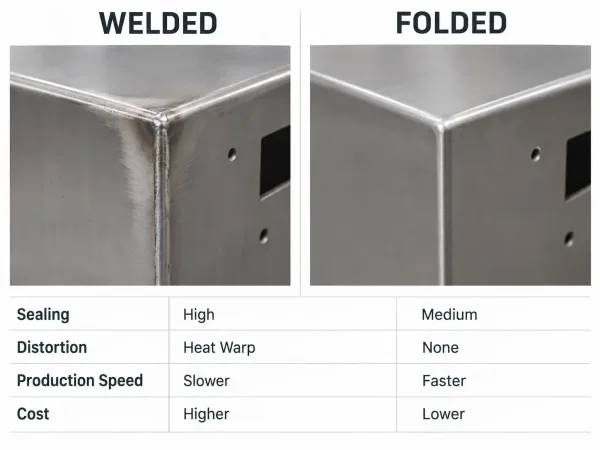
Technical comparison of welded and folded corner joints for enclosure design and manufacturing decisions.
| Dimension | Welded Corners | Folded Corners |
|---|---|---|
| Structural strength | Highest — creates a permanent metallurgical bond | High — maintains material integrity, but the joint is not fused |
| Sealing performance | Excellent — continuous weld bead can achieve IP66/IP67 | Good to moderate — depends on gasket design and flange overlap |
| Heat distortion | Significant — 0.3–0.8 mm warpage per weld seam on thin steel | None — no heat input |
| Surface finish | Requires post-weld grinding and recoating | Clean — no finishing needed at the corner |
| Production speed | Slower — welding + grinding + finishing adds 3–10 minutes per part | Fast — forming takes seconds per corner |
| Cost per part | Higher — labor, consumables, and rework | Lower — fewer process steps |
| Geometry limits | Flexible — can join complex shapes and dissimilar thicknesses | Limited by bend radius and material ductility |
| Material compatibility | Works on all metals; galvanized and coated metals require extra care | Best on ductile metals (CRS, aluminum, stainless); thick plates above 3 mm are harder to fold |
| IP rating potential | IP66/IP67 achievable with continuous weld | IP54 achievable with gasketed flanges; higher ratings require secondary sealing |
When to Specify Welded Corners
Welded corners are the right choice when any of the following conditions apply.
High IP rating is required. For IP66, IP67, or washdown environments, a continuous weld provides a permanent sealed corner that no gasket can reliably match over the product lifetime. Outdoor telecom enclosures, food processing equipment, and marine cabinets typically require welded corners.
Structural loads are significant. If the enclosure must support heavy internal components, resist vibration, or withstand mechanical impact, welded joints provide the highest bond strength. Rack-mounted server enclosures and industrial machine guards often fall into this category.
The geometry cannot be folded. When the enclosure design includes complex three-dimensional shapes, irregular angles, or joints between panels of different thicknesses, welding is the only practical option.
The budget allows for higher unit cost. Welded corners add 20–30% to the per-part cost compared to folded corners, primarily due to labor, consumables, and post-weld finishing. For low-volume projects — under 500 units — this cost premium may be acceptable if the performance requirements demand it.
When to Specify Folded Corners
Folded corners are the better choice in most standard enclosure applications.
IP54 or lower is sufficient. For indoor electrical panels, control boxes, and server racks, a well-designed gasketed flange with folded corners can reliably achieve IP54. The gasket compresses evenly along the continuous flange, and there is no weld bead to create stress concentration points.
Production speed and cost matter. Folded corners eliminate welding, grinding, and recoating steps. For high-volume orders — 1,000 units or more — the cost savings are substantial, often 25–40% lower per-part cost compared to welded corners.
Surface finish is critical. Folded corners maintain the original coating integrity. No grinding means no risk of thinning the parent metal or creating localized corrosion points. For powder-coated or anodized enclosures, folded corners preserve the finish quality.
The enclosure geometry is straightforward. Standard rectangular enclosures with 90° corners and inside radii of 1.0× material thickness or greater are ideal candidates for folding. The press brake can form these corners quickly and consistently.
How Material and Thickness Affect the Choice
The material type and sheet thickness are the two most important variables in the welded-versus-folded decision. The table below summarizes the key constraints.
| Material | Foldable Thickness Range | Welding Notes |
|---|---|---|
| Cold-rolled steel (CRS) | 0.8–3.0 mm | Easy to weld; distortion manageable with balanced sequences |
| Galvanized steel (SGCC) | 0.8–2.5 mm | Zinc coating burns off near weld; requires post-weld zinc repair |
| Stainless steel | 0.8–2.0 mm | More springback than CRS; tighter tooling needed for consistent folds |
| Aluminum | 0.8–2.5 mm | Prone to cracking on tight radii in tempered alloys (e.g., 6061-T6); welding requires TIG or MIG with appropriate filler |
General rule: For sheets under 2.0 mm, folding is almost always more cost-effective and produces better cosmetic results. For sheets above 3.0 mm, welding becomes more practical because the increased thickness resists distortion and the fold radius becomes impractically large. Between 2.0 and 3.0 mm, the decision depends on the specific material, the enclosure geometry, and the IP requirement.
How IP Requirements Influence the Decision
The target IP rating is often the deciding factor between welded and folded corners. The table below maps IP ranges to the recommended corner joint approach.
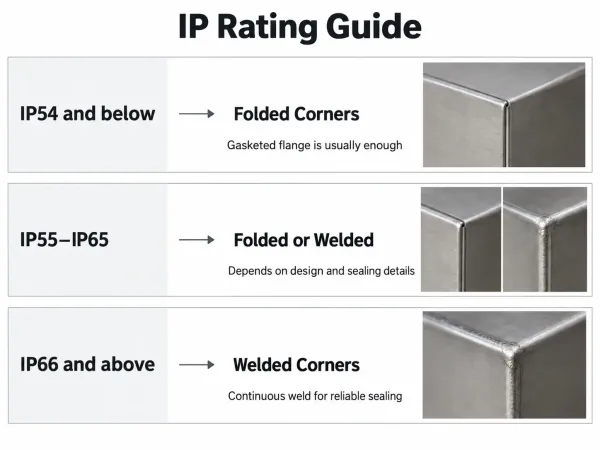
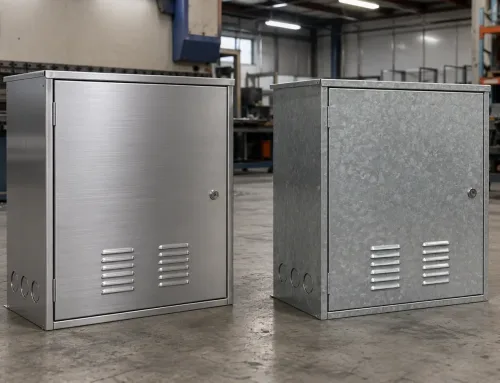
Engineering guide showing when folded or welded corners are recommended based on enclosure IP rating.
| IP Range | Recommended Corner Joint | Reasoning |
|---|---|---|
| IP54 and below | Folded corners with gasketed flange | Gasket provides the environmental seal; corner joint only needs structural integrity |
| IP55–IP65 | Folded corners possible with careful design; welded preferred for reliability | Requires continuous gasket channels, proper drainage, and sealed fastener points; folded corners must avoid capillary paths |
| IP66 and above | Welded corners required | Continuous weld bead creates a permanent barrier independent of gasket compression |
Key point: Specifying a high IP rating on the drawing without specifying the corner joint method is a common source of RFQ delays. Manufacturers will ask for clarification because the IP requirement directly determines whether welding is needed — and that affects cost, lead time, and DFM considerations.
DFM Considerations for Corner Joints
From a manufacturer’s perspective, the corner joint specification on your drawing triggers a series of production decisions. Getting it right at the RFQ stage avoids costly back-and-forth.
Specify the corner joint type explicitly. Do not assume the manufacturer will choose the right method. Write “welded corner — continuous weld, grind smooth” or “folded corner — 1.0 mm inside radius” on the drawing. Ambiguous corner notes lead to technical clarification requests that delay quoting.
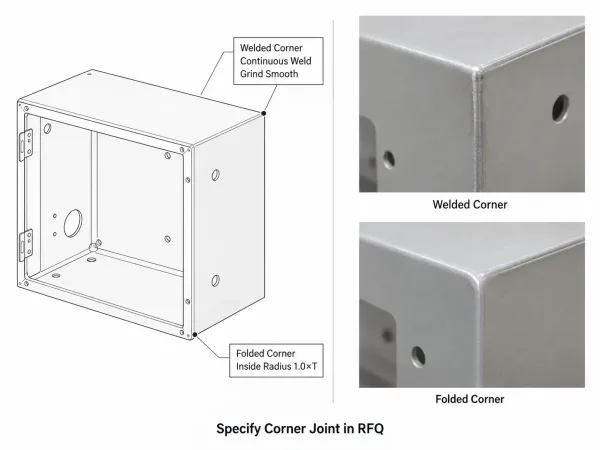
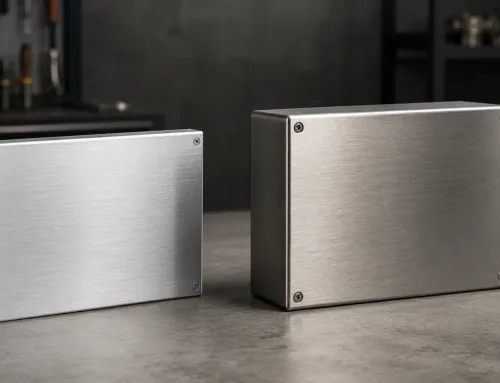
Drawing-based guidance for specifying welded or folded corner joints in enclosure RFQs and DFM reviews.
Account for weld distortion in your tolerance stack. If you specify welded corners, add 0.5–1.0 mm of distortion allowance to adjacent flat surfaces. Holding ±0.2 mm flatness on a panel with eight welded corners is not realistic without post-weld straightening, which adds cost.
Consider the coating sequence. Welded corners must be ground before painting or powder coating. If the drawing specifies a coating thickness of 60–80 µm, the weld area may require additional coating passes to achieve uniform coverage. Folded corners do not have this issue.
Think about gasket seating. For folded corners with a gasketed seal, ensure the gasket channel is continuous around the corner. A break in the gasket path at the corner fold is a common failure point in IP testing.
Review the flange design. Folded corners require a flange overlap of at least 1.5× material thickness for structural integrity. If the enclosure design has very short flanges, the corner may not fold cleanly or may crack at the bend line.
Key Takeaways
- Welded corners provide the highest structural strength and sealing performance, but they introduce heat distortion, require post-weld finishing, and cost more per part.
- Folded corners are faster, cheaper, and preserve surface finish, but they have geometry limits and may not meet high IP ratings without secondary sealing.
- Material and thickness are the primary decision drivers: thin, ductile metals favor folding; thick plates or complex geometries favor welding.
- IP requirements often make the decision for you: IP54 and below → folded; IP66 and above → welded.
- Specify the corner joint type on your drawing to avoid RFQ delays and ensure the manufacturer quotes the correct process.
FAQs
Need a DFM review on your enclosure design? Our engineering team can evaluate your corner joint specifications and provide recommendations within 24 hours. Contact us to get started.