
When a sheet metal order arrives with material test reports, procurement teams often see a field labeled “heat number” and assume it is just a serial number for internal tracking. Others wonder why they cannot simply rely on the material grade—like 304 stainless steel or A36 carbon steel—to ensure consistency. The confusion is understandable because heat numbers are rarely explained in standard engineering curricula, yet they are fundamental to material traceability in steel production.
For buyers sourcing custom sheet metal parts, this gap in understanding can lead to unclear specifications, missed quality checks, and avoidable disputes when material properties vary unexpectedly between orders.
What Exactly Is a Heat Number?
A heat number is a unique alphanumeric identifier assigned by a steel mill to a specific batch of steel melted in a single furnace charge—known as a “heat.” This number is stamped, tagged, or otherwise marked on the material after it is rolled into plate, sheet, or coil form. Unlike a lot number, which a service center or fabricator may assign to group multiple heats for inventory purposes, a heat number traces directly back to the original melt.
Typical heat numbers are 4–8 characters long, combining letters and numbers (e.g., “H1234” or “L8A7B2”). They appear on mill test certificates (MTCs), material tags, and sometimes directly on the metal surface via inkjet printing or engraving.
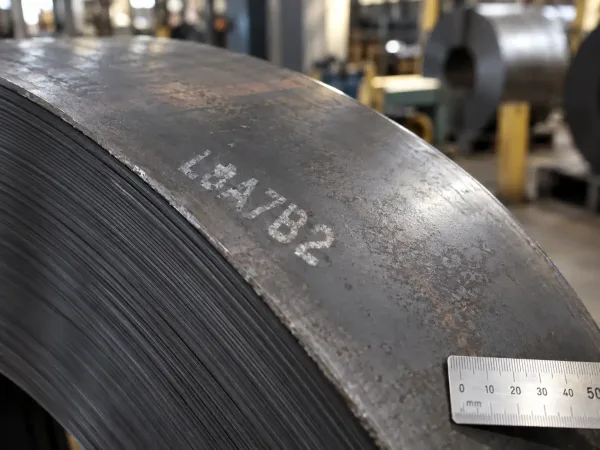
Detailed photograph showing a steel coil edge with an inkjet-printed heat number “L8A7B2”, with a ruler showing scale and the marking method clearly visible.
How Heat Numbers Are Created in Steel Production
The heat number is generated at the steel mill during the melting process. When a furnace charge is tapped into a ladle, the mill assigns a unique identifier to that entire batch. This number follows the steel through every subsequent step—casting, rolling, cooling, and cutting—ensuring that all material from that single melt can be linked together.
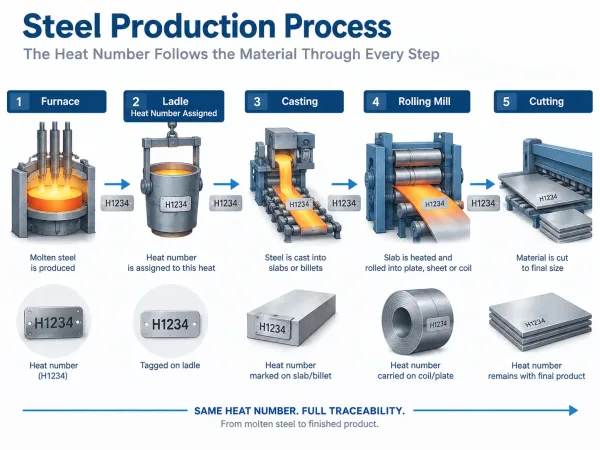
Simplified process diagram showing steel production steps: Furnace → Ladle (heat number assigned) → Casting → Rolling → Cutting, with each step connected by arrows and the heat number symbol moving through the chain.
The marking method varies by mill and product form. For plate and sheet, the heat number is often stamped on the edge or surface before shipment. For coils, it may appear on the packaging label or be encoded in a bar code. Regardless of the marking method, the heat number remains the primary link between the finished steel product and its original chemical composition and mechanical properties.
The Link Between Heat Numbers and Mill Test Certificates
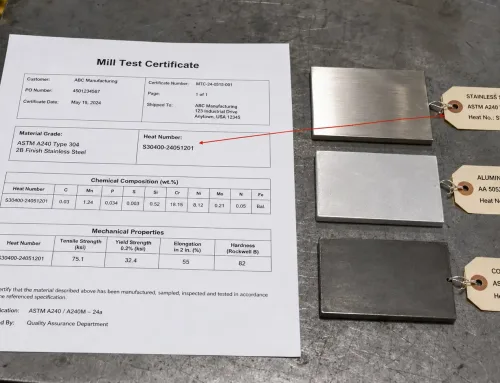
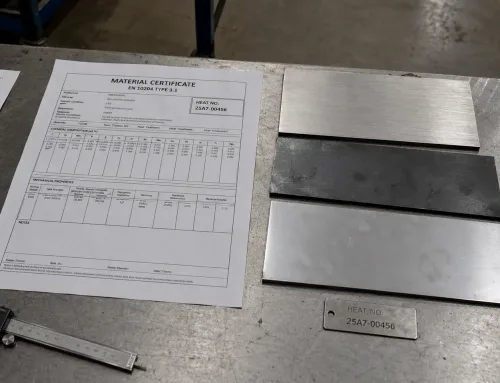
A mill test certificate (MTC) is the official document that reports the chemical composition, mechanical properties, and test results for a specific heat of steel. The heat number appears prominently on the MTC, serving as the key that ties the physical material to its certified test data.
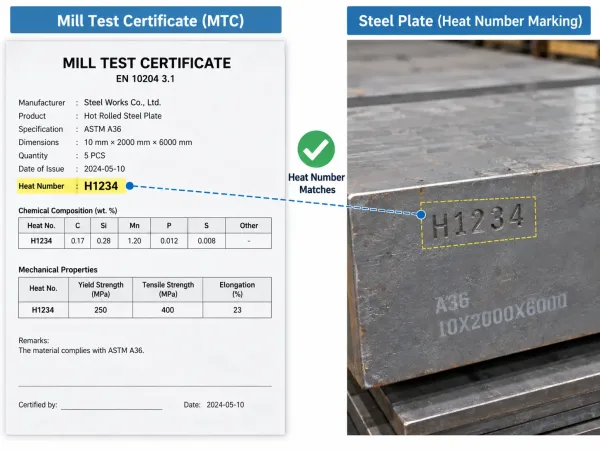
Side-by-side comparison showing a mill test certificate (MTC) with heat number “H1234” highlighted, next to a steel plate with the same heat number stamped on it, connected by a dotted line indicating verification.
Without the heat number, an MTC is incomplete because there is no way to verify that the report applies to the actual material received. For example, if a shipment of 304 stainless steel arrives with an MTC showing chemistry and tensile test results, but the heat number on the MTC does not match the heat number stamped on the material, the certificate cannot be trusted. This linkage is what makes heat number traceability essential for quality assurance.
How Heat Numbers Enable Material Traceability
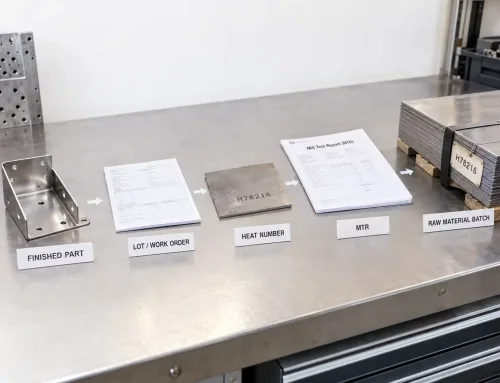
Heat numbers create a traceability chain that extends from the steel mill through every handling step to the final fabricated part. When a fabricator like SR-MFG receives steel coil or plate, the heat number is recorded during incoming inspection and linked to the work order for each cut piece. This allows any finished part to be traced back to its original mill heat, enabling root-cause analysis if material issues arise later.
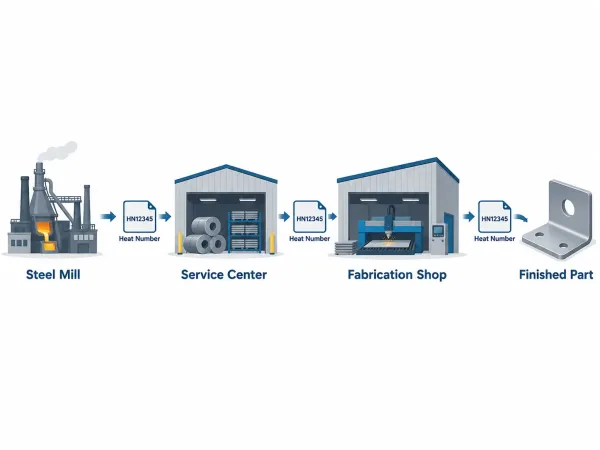
Flowchart showing the traceability chain: Steel Mill (heat number origin) → Service Center (heat number recorded) → Fabricator (heat number linked to work order) → Final Part (heat number traceable back), with icons representing each stage.
In practice, this traceability is critical for industries with strict material certification requirements, such as aerospace, pressure vessels, and medical devices. Even for commercial sheet metal parts, heat number traceability helps resolve disputes about material quality, prevents accidental mixing of different material batches, and supports compliance with customer specifications.
Specifying Heat Number Requirements on Your Orders
To ensure heat number traceability, buyers should explicitly state their requirements in the purchase order or drawing notes. A simple specification like “Material must be traceable to mill heat number with MTC” is often sufficient for standard orders. For critical applications, more detailed requirements may be needed, such as “Heat number must be marked on each piece and referenced on all test reports.”
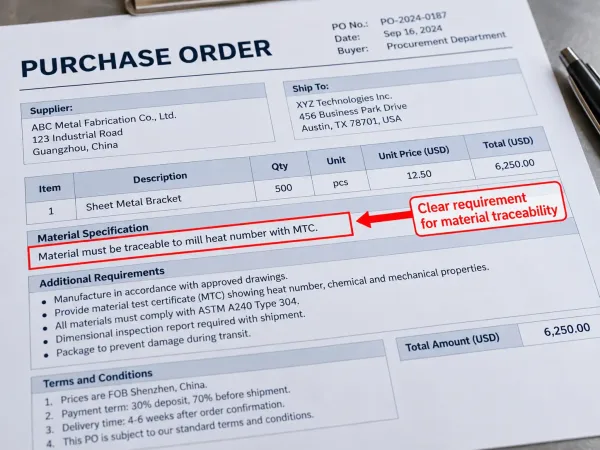
Example purchase order excerpt showing the specification field with text “Material must be traceable to mill heat number with MTC”, with a callout highlighting this requirement and its importance.
It is important to understand that heat number traceability may add cost or lead time in some scenarios. For small orders cut from stock material, the fabricator may need to source from a specific mill batch to maintain traceability, potentially limiting material availability. However, for most production orders, the additional effort is minimal compared to the risk mitigation it provides.
What Happens When Heat Numbers Are Missing or Wrong
When heat numbers are missing, illegible, or do not match between material and documentation, several problems can occur. First, material mix-ups become more likely—different heats of the same grade can have slight variations in chemistry or mechanical properties, which may affect formability, weldability, or corrosion resistance.
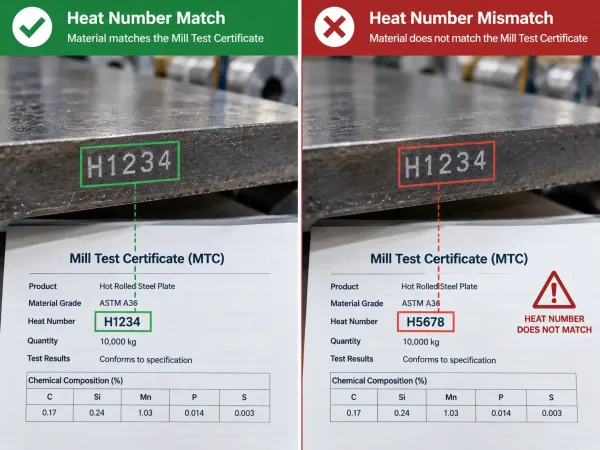
Split image showing: Left side – correct match (steel plate with “H1234” next to MTC with “H1234”, green checkmark), Right side – mismatch (steel plate with “H1234” next to MTC with “H5678”, red X and warning symbol).
Second, quality disputes become difficult to resolve. Without a clear heat number link, it is challenging to determine whether a material issue originated at the mill, during processing, or in the customer’s application. Third, compliance failures may result if industry standards or customer specifications require full material traceability.
In one real-world example, a shipment of laser-cut stainless steel brackets was held at incoming inspection because the heat number on the MTC did not match the heat number on the material tags. The discrepancy required contacting the service center, obtaining corrected documentation, and delaying production by five days—all of which could have been avoided with proper heat number verification at each transfer point.
Key Takeaways
Heat numbers are not arbitrary serial numbers—they are the foundation of material traceability in steel production. By specifying heat number requirements on your sheet metal orders, you protect your supply chain against material mix-ups, quality disputes, and compliance failures.
Fabricators like SR-MFG use heat numbers to ensure material integrity from incoming inspection through final shipment. When you include clear traceability specifications in your purchase orders, you enable your manufacturing partner to maintain the chain of custody that links every finished part back to its original mill heat.