
When you receive a quote for custom sheet metal parts, the pricing table often shows multiple rows: one price for 10 units, a lower price for 50, and an even lower price for 100. At first glance, it seems straightforward—buy more, pay less per unit. But the moment you ask the supplier to explain why the price drops at each tier, the answer often involves a mix of machine setup time, material nesting efficiency, and production scheduling benefits that do not map neatly to anything on your drawing.
Understanding what drives a price break helps you evaluate quotes more accurately, negotiate from a position of knowledge, and avoid paying for inefficiencies you could have designed out of the part.
What Is a Price Break?
A price break is a tiered pricing structure where the unit price decreases as the order quantity increases. In custom manufacturing, it is not a discount for loyalty or volume purchasing in the retail sense. Instead, it reflects the way fixed costs—such as machine setup, tooling preparation, and first-article inspection—get amortized across a larger number of parts.
Unlike minimum order quantity (MOQ), which sets the smallest number of parts a supplier will produce, a price break defines the quantity thresholds at which the unit price changes. A supplier might accept an order for 5 units at 25each,butoffer18 each at 25 units and $14 each at 100 units. The price break is the mechanism that makes those tiers possible.
Most custom manufacturing quotes include two to four price tiers. The first tier covers prototype or low-volume runs where setup costs dominate. Subsequent tiers reflect increasing production efficiency as volume rises.
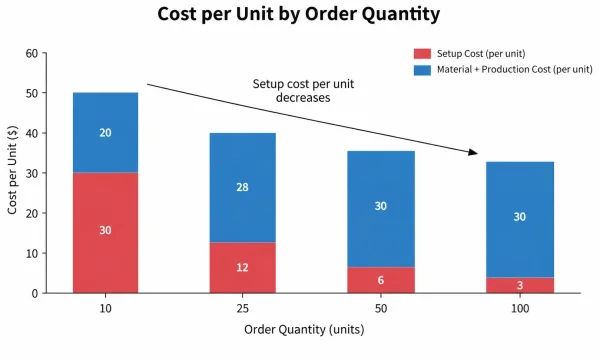
This diagram visualizes how setup costs are distributed across different quantity tiers, explaining why unit prices decrease as order volume increases.
Why Do Suppliers Offer Price Breaks?
Price breaks are not arbitrary discounts. They reflect the economics of how custom parts move through a production facility.
Fixed costs do not scale linearly. Whether you order 10 parts or 1,000, the supplier must program the laser cutter, set up the press brake tooling, and run a first-article inspection. These activities take the same amount of time regardless of order size. When that fixed cost is divided across 10 parts, each part absorbs a larger share than when divided across 1,000 parts.
Production scheduling favors larger batches. A machine changeover between orders consumes time that could be spent cutting parts. Suppliers prefer longer production runs because they reduce the number of changeovers per shift, increasing overall machine utilization. Price breaks incentivize customers to consolidate orders into larger batches.
Material procurement becomes more efficient. Buying sheet stock in standard mill quantities (full sheets or full coils) reduces per-unit material cost. When a customer orders enough parts to justify cutting from full sheets rather than remnants, the supplier can pass those savings through.
The Three Cost Drivers Behind Price Breaks
Setup Cost: How Fixed Costs Divide Across Units
Every custom manufacturing order begins with setup—the process of preparing the machine, tooling, and program to produce a specific part. For laser cutting, setup includes nesting the part geometry onto a sheet, setting focus and power parameters, and running a test cut. For bending, setup involves installing the correct punch and die combination and programming the bend sequence.
Setup time is fixed: it takes the same 15 minutes whether the machine then cuts 10 parts or 10,000. At 10 parts, each part absorbs 1.5 minutes of setup cost. At 1,000 parts, each part absorbs less than one second. This is why the first price tier—where setup costs are concentrated—is always the most expensive per unit.
Some suppliers quote setup as a separate line item. Others build it into the unit price. Either way, understanding that setup cost exists and how it divides across quantity helps you evaluate whether a price break is reasonable.
Material Utilization: How Nesting Efficiency Improves with Quantity
Laser cutting, punching, and waterjet cutting all involve nesting multiple parts onto a single sheet of raw material. The efficiency of that nest—how much of the sheet becomes finished parts versus scrap—directly affects material cost per part.
At low quantities, nesting efficiency is often poor. Cutting 5 parts from a 4×8-foot sheet leaves large areas of unused material. The supplier may need to cut from a smaller sheet or a remnant, which costs more per square inch than standard sheet stock.
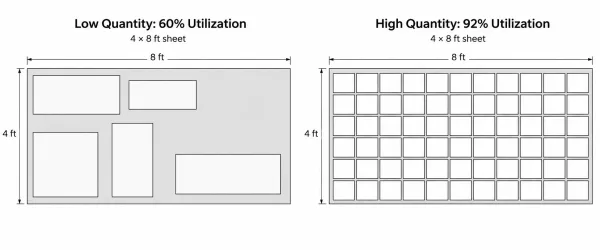
This comparison shows how material utilization improves as order quantity increases, reducing waste and lowering per-unit material cost.
As quantity increases, the nesting algorithm can arrange parts more efficiently. At 50 parts, the nest might use 85% of the sheet. At 500 parts, it might reach 92%. This improvement in material utilization translates directly into lower per-unit material cost—and shows up in the price break.
Volume Economics: How Production Scheduling Affects Cost
Beyond setup and material, there are production scheduling efficiencies that favor larger orders:
Machine changeovers. Each time a machine switches from one part number to another, there is downtime. Larger orders reduce the number of changeovers per production shift, meaning the machine spends more time cutting and less time reconfiguring.
Batch processing. Some secondary operations—such as deburring, powder coating, or assembly—are more efficient when performed on a continuous flow of identical parts. The cost per unit for these operations drops as batch size increases.
Quality inspection. First-article inspection requires measuring key dimensions and documenting results. For small orders, the inspection cost per unit is high. For larger orders, it is negligible.
Inventory and logistics. Shipping 1,000 parts in one shipment costs less per part than shipping 10 parts in 100 separate shipments. Suppliers factor this into their pricing structure.
How to Read a Price Break Quote
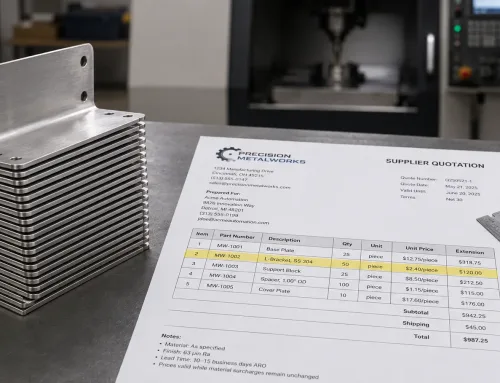
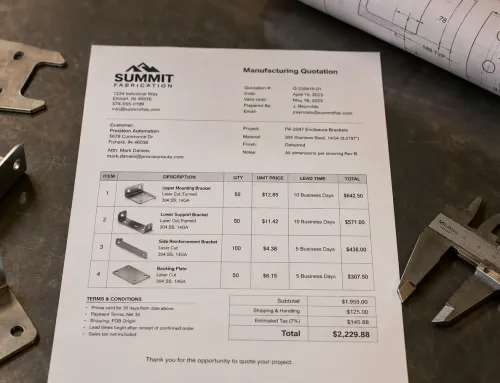
A typical price break quote might look like this:
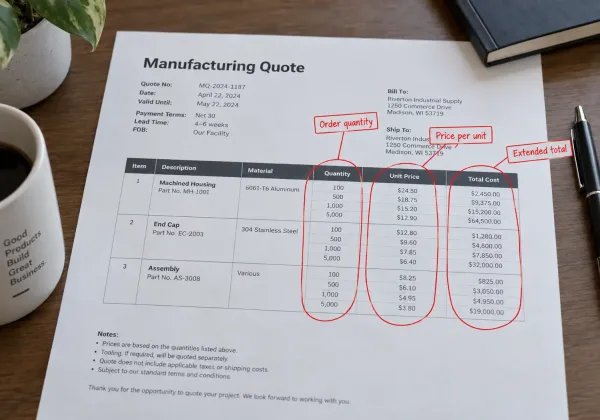
This annotated example shows how to read a price break quote, highlighting important elements like tier thresholds, unit prices, and total costs.
| Process Path | Typical Ra | Surface Character |
|---|---|---|
| Abrasive belt / brush (No. 4 finish) | 0.4–0.8 µm | Directional grain, linear texture |
| Bead blasting (fine glass beads) | 0.8–1.6 µm | Non-directional, uniform dimpled texture |
| Powder coating (satin formulation) | Coating-dependent; not directly comparable to bare-metal Ra | Smooth, non-directional sheen |
| Chemical etching | 0.2–0.6 µm | Non-directional, very fine matte texture |
The first thing to check is whether the price break reflects real cost savings or just a marketing strategy. Ask the supplier to break down the cost drivers: how much is setup, how much is material, and how much is production efficiency.
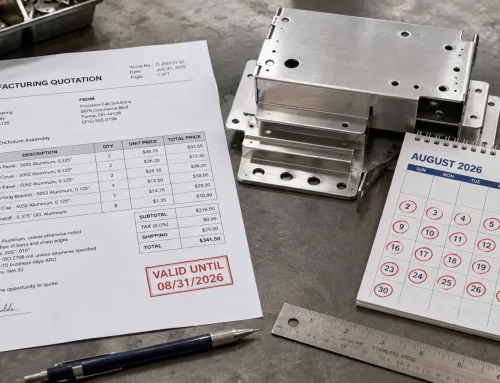
The second thing to watch for is the cliff effect—a sudden, steep price drop between two tiers that does not correspond to a significant change in cost drivers. This sometimes occurs when a supplier wants to steer you toward a specific order quantity that suits their production schedule.
The third thing to consider is whether the unit price at each tier includes the same scope of work. A lower unit price might exclude secondary operations (deburring, finishing, inspection) that were included in the higher-priced tier.
How to Evaluate Which Tier Offers the Best Value
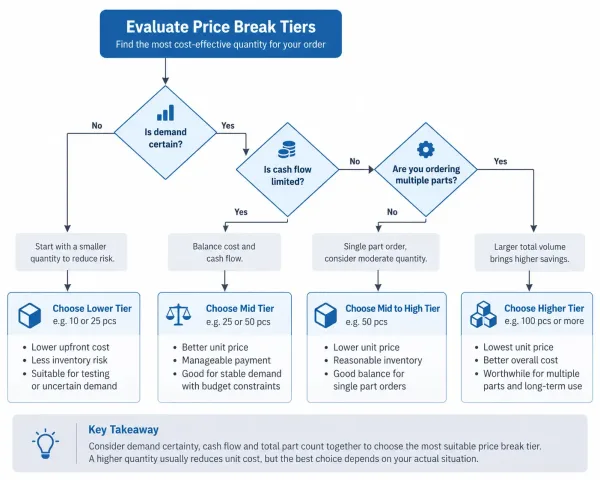
This flowchart provides a decision framework for selecting the optimal quantity tier based on demand certainty, cash flow, and total cost considerations.
The lowest unit price does not always mean the lowest total cost. To evaluate which tier is right for your project, consider:
Total cost of ownership. Beyond the quoted price, factor in inventory holding costs, storage space, and the risk of design changes rendering the parts obsolete.
Demand certainty. If you are confident you will use all 1,000 parts within the next 12 months, the higher volume tier makes sense. If demand is uncertain, the lower volume tier—even at a higher unit price—may be the safer financial decision.
Cash flow impact. A 1,200ordertiesupmorecapitalthana250 order. For startups or projects with tight budgets, the lower volume tier may be necessary even if the unit price is higher.
Supplier relationship. If you plan to order repeatedly, starting with a smaller quantity allows you to evaluate quality and delivery reliability before committing to larger volumes.
Practical Tips for Buyers
Ask for a cost breakdown. Understanding how much of the unit price is setup, material, and production cost helps you identify where savings are genuine and where they are not.
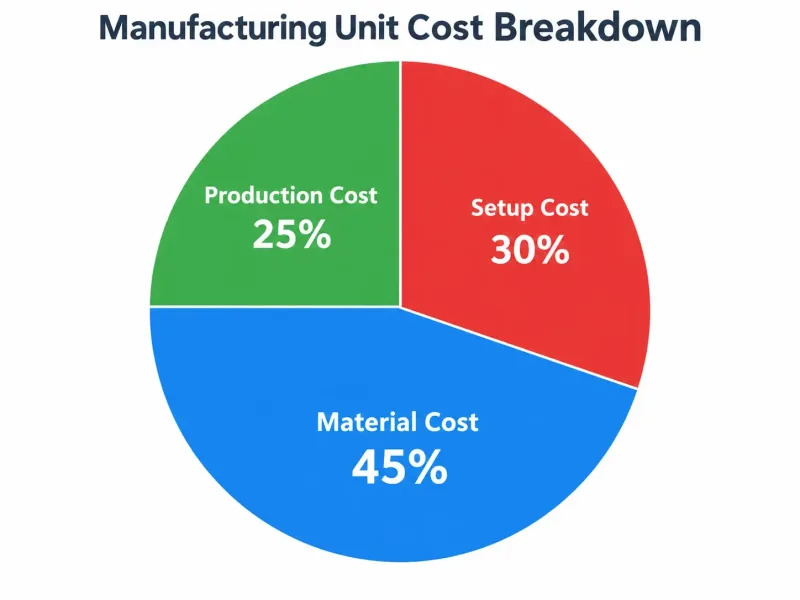
This pie chart illustrates how setup cost, material cost, and production cost typically contribute to the unit price in custom manufacturing.
Design for standard sheet sizes. Parts that nest efficiently on standard 4×8-foot sheets will always cost less than parts that require custom sheet sizes or produce excessive scrap.
Consider combining orders. If you have multiple part numbers, ask whether the supplier can run them in a single production batch to reduce setup costs across the board.
Negotiate the tier thresholds, not just the prices. Sometimes moving the quantity breakpoint from 50 to 40 parts makes more sense for your inventory planning than negotiating a 5% price reduction at the 50-part tier.
Watch for hidden costs. A lower unit price might exclude packaging, inspection documentation, or secondary operations that were included in the original quote.

This checklist summarizes the key items buyers should verify when reviewing tiered pricing quotes from manufacturers.
Key Takeaways
- Price breaks reflect real cost efficiencies: fixed setup costs divide across more units, material nesting improves, and production scheduling becomes more efficient.
- The lowest unit price is not always the best deal—consider total cost of ownership, demand certainty, and cash flow impact.
- Understanding the three cost drivers (setup, material utilization, volume) helps you evaluate quotes more accurately and negotiate from a position of knowledge.
- Ask suppliers to explain the reasoning behind each tier. A transparent pricing structure is a sign of a well-run manufacturing operation.
FAQ
Need help evaluating a price break for your next sheet metal project?
Upload your drawings for a free DFM review and transparent quote with clear price tier explanations.