Home ->
Abrasive Blasting Surface Finishing for Metal Parts
In sheet metal fabrication, we don’t settle for “good enough” surface prep. With 15 years of experience, we know abrasive blasting isn’t just cleaning—it’s a controlled, verifiable foundation for coating adhesion and consistent appearance.
We blast to the visual cleanliness criteria of ISO 8501-1 Sa 2½, where any allowable residue is limited to light spot or streak staining. Consistency is confirmed using ISO 8503 surface profile comparators/standard reference panels. The surface profile (anchor pattern) is set to match the coating system and customer specification—typically within a defined range (e.g., 40–70 μm). When required, we document and re-verify the profile using replica tape and/or profile gauges.
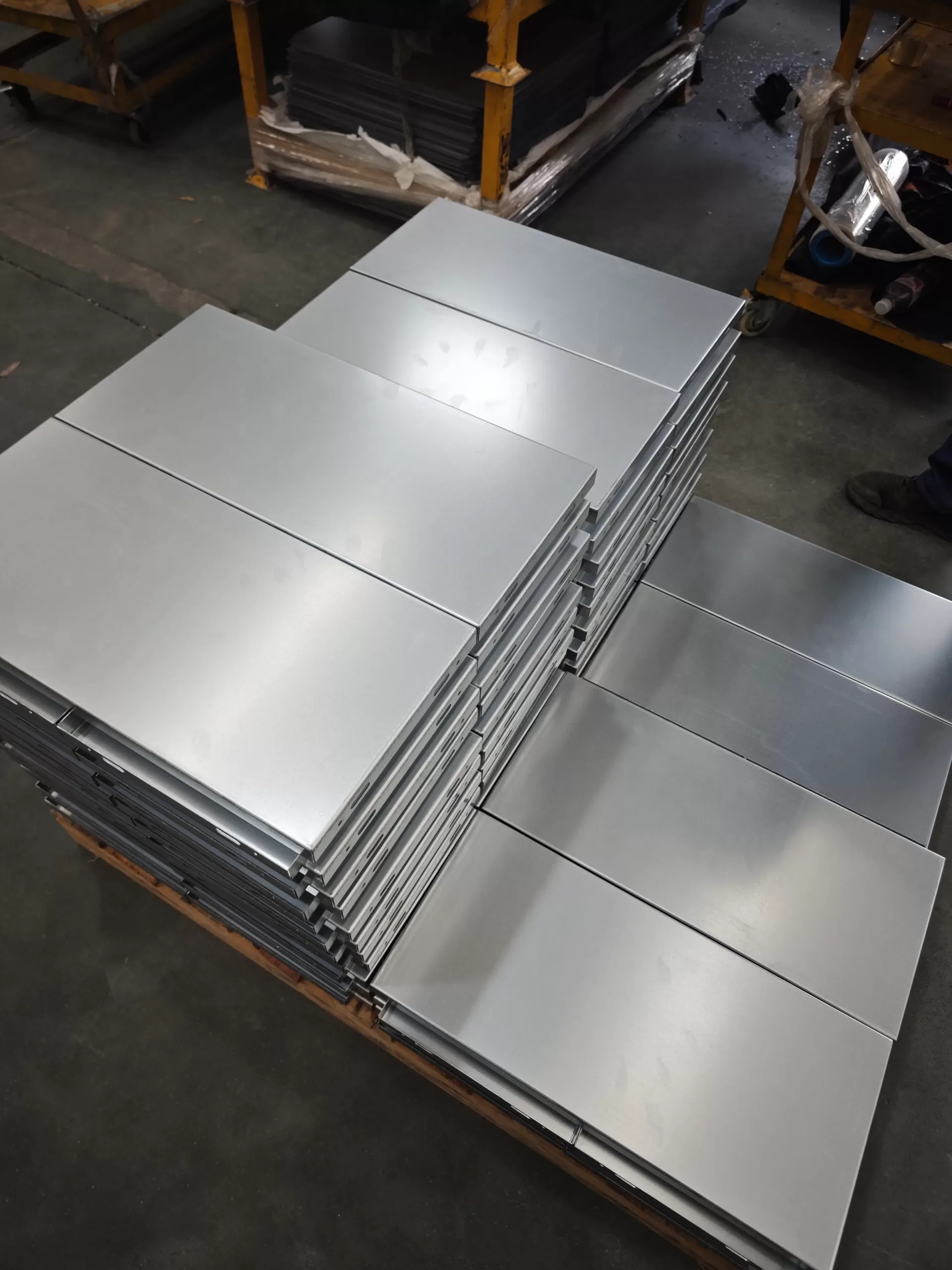
Applications of Metal Sandblasting (Abrasive Blasting)
Medical devices: Sterilizer/cleaning equipment housings, surgical instruments, and panels/covers for medical imaging equipment.
New energy: Battery equipment enclosures/cabinets, PV (solar) mounting brackets, and EV components.
Automotive: Engine blocks, aluminum alloy wheels, chassis parts, and body panels.
Electronics & precision manufacturing: Smartphone mid-frames, metal computer housings, PCB contact areas, and precision instrument enclosures.
What Problems Does Metal Sandblasting Solve?
Stubborn contamination and mill scale that are hard to remove
Abrasive blasting efficiently removes rust, mill scale, old coatings, weld spatter, and persistent surface contaminants. It also delivers relatively consistent cleaning results on complex geometries—creating a stable foundation for subsequent coatings and finishes.
Root causes of coating blisters or peeling: poor adhesion and insufficient surface profile
Blasting creates a controlled anchor pattern (surface profile) and removes adhesion-inhibiting contaminants, which significantly improves coating system reliability. Industry experience consistently shows that a meaningful share of early coating failures trace back to inadequate surface preparation.
Adhesion can be verified to standards such as ASTM D3359 (tape test) and ASTM D4541 (pull-off) with reports available when required.
Throughput and batch-processing needs
Compared with manual sanding, blasting is easier to standardize and automate for repeatable, high-throughput processing. Wet methods can reduce airborne dust, but proper engineering controls and cleaning practices are still required to meet EHS and dust-control requirements.
How we prove it (inspection and documentation)
- Cleanliness: visual acceptance per ISO 8501-1 (e.g., Sa 2½)
- Surface profile / roughness: measured and recorded per ISO 8503 or ASTM D4417 (comparison panels, replica tape, or a profilometer)
- Dust contamination: ISO 8502-3 tape test
- Soluble salts (when required): ISO 8502-9 (Bresle method)
- Optional verification: adhesion reports (ASTM D3359 / D4541) and salt spray reports (ISO 9227) if specified by the customer

Metal Abrasive Blasting FAQs
Metal Abrasive Blasting Technical Resources