
Most procurement teams spend weeks evaluating new suppliers. They audit facilities, check certifications, negotiate pricing, and run first-article inspections before releasing a single purchase order.
But when was the last time you formally reviewed the suppliers you already trust?
In sheet metal fabrication, the risk rarely comes from the supplier you just qualified. It comes from the one you have been ordering from for three years — the one whose equipment has changed, whose welders have turned over, and whose material sourcing may have shifted without anyone sending you a notification. An annual supplier review turns those blind spots into data points you can act on before they become quality escapes or delivery failures.
Why Annual Reviews Catch What Day-to-Day Monitoring Misses
The Hidden Drift Problem
A supplier’s process is not static. Press brake tooling wears. Laser consumables degrade. Operators rotate between shifts. Material lots vary in composition and surface quality. These changes are gradual, and individually each one may stay within tolerance. But over twelve months, the cumulative effect can shift your parts away from the original qualification baseline.
Day-to-day quality control and inspection — including incoming inspection, delivery tracking, and defect logs — catches acute failures. It does not catch slow drifts that stay within specification limits but erode process capability (Cpk). An annual review forces you to look at trends rather than individual data points.
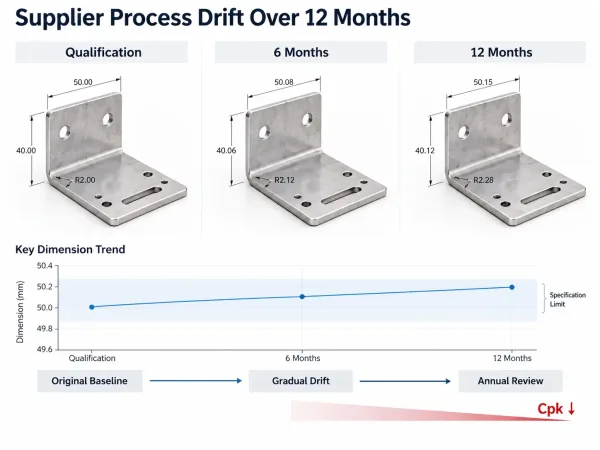
Gradual process drift can remain within tolerance while moving away from the original qualification baseline.
What “No Complaints” Really Means
A clean complaint log does not mean your supplier is performing well. It may mean your inspection sampling is too thin to catch intermittent defects, or that your engineering team has been absorbing small deviations rather than filing non-conformance reports. The annual review is the moment to ask: are we seeing zero problems because the process is excellent, or because we are not looking hard enough?
Assemble the Right Review Team Before You Start
A supplier review is not a procurement-only exercise. The purchasing team tracks pricing and delivery, but they rarely have visibility into weld quality trends, dimensional drift on forming operations, or surface finish consistency. A credible annual review requires input from four functions:
- Procurement evaluates pricing competitiveness, contract compliance, communication responsiveness, and lead time trends.
- Quality reviews defect rates, non-conformance reports, corrective action closure rates, and incoming inspection data.
- Engineering assesses process capability, equipment condition, design-for-manufacturability feedback quality, and the supplier’s ability to handle tighter tolerances or new materials.
- Production provides ground-level feedback on fit-up issues, packaging damage, missing hardware, and assembly-line rejects that may not appear in formal quality records.
Each function scores the supplier from its own data. The composite score is what drives the final evaluation.
Review Point #1 — Quality Performance Metrics
Quality is the highest-weighted dimension in most supplier evaluation frameworks, and for good reason. A sheet metal supplier can be on-time and cost-competitive, but if parts arrive out of tolerance, every downstream process suffers.
PPM Defect Rate and CPK Targets
Track defects in parts per million (PPM) rather than counting incidents. A supplier shipping 5,000 parts per month with 3 rejected is not performing the same as one shipping 500 parts with 3 rejected. PPM normalizes for volume. For critical dimensions, require a minimum Cpk of 1.33 — this means the process is capable of producing parts within tolerance with a comfortable margin.
Sheet Metal-Specific Quality Indicators
General PPM tells part of the story. A sheet metal inspection plan should also track:
- Weld defect rate: porosity, undercut, incomplete fusion — expressed as a percentage of inspected weld joints.
- Dimensional out-of-tolerance rate: particularly on bend angles, hole positions, and flatness after forming.
- Surface finish consistency: especially for visible parts where Ra values or coating thickness must stay within a narrow range.
- First-article pass rate: how often the supplier’s first production run meets all specifications without rework.
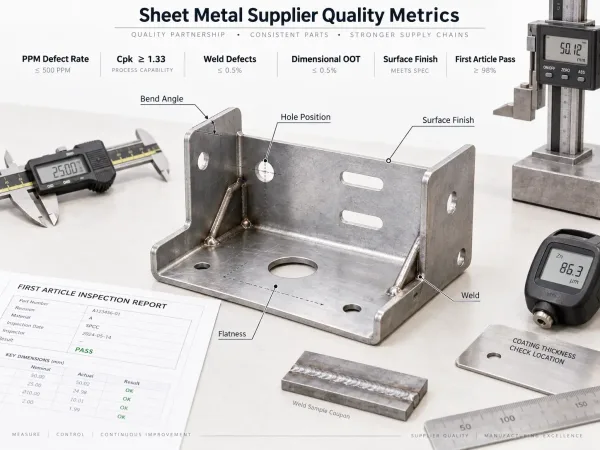
Key quality metrics used to evaluate sheet metal supplier performance.
Review Point #2 — On-Time Delivery Performance
Tracking OTD Trends, Not Just Averages
An annual on-time delivery (OTD) rate of 92% sounds acceptable until you look at the monthly trend and discover that the supplier consistently misses deadlines in Q4 due to capacity constraints from other customers. Track OTD monthly and look for patterns — seasonal dips, degradation over time, or correlation with specific part families or materials.
Root Cause Analysis for Delivery Gaps
When the supplier misses a delivery date, categorize the root cause:
- Supplier-controlled: poor scheduling, capacity overcommitment, internal quality rejects requiring rework.
- Externally driven: raw material delays (steel mill lead times), customer-side engineering changes, force majeure.
Only supplier-controlled delays should count against their OTD score. External factors belong in the risk assessment section of your review.
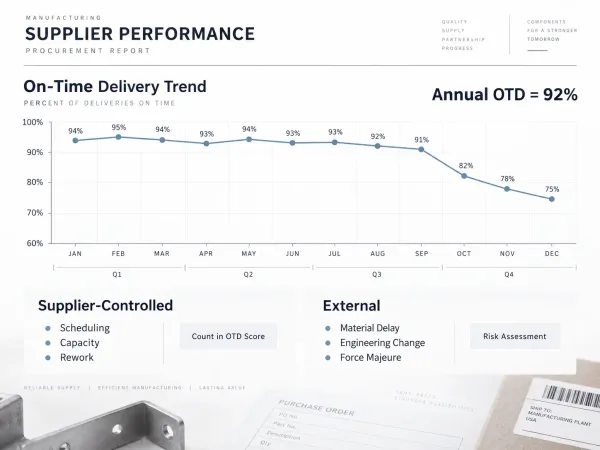
Monthly OTD trends reveal delivery problems that annual averages can hide.
Review Point #3 — Certifications and Compliance Status
Do not just check whether the supplier “has ISO 9001.” Verify the following:
- Scope of certification: Does it cover the specific processes used for your parts? A shop certified for laser cutting and bending may not be certified for welding.
- Validity dates: An expired certificate is worse than no certificate — it suggests the supplier allowed their QMS to lapse.
- Audit findings: Request a summary of the last surveillance audit. Major non-conformances that remain open are a red flag.
For sheet metal fabrication, the certifications most relevant to buyers include:
| Certification | What It Covers | When It Matters |
|---|---|---|
| ISO 9001 | General quality management system | Baseline for all suppliers |
| AWS D1.1 | Structural steel welding | Any welded assembly |
| ISO 3834 | Welding quality management system | Critical welded components |
| IATF 16949 | Automotive quality management | Automotive supply chain |
| AS9100D | Aerospace quality management | Aerospace and defense parts |
| ISO 14001 | Environmental management | Sustainability requirements |
Review Point #4 — Material Traceability and Documentation
An MTR review verifies that the mill test report confirms the chemical composition and mechanical properties of the raw material used for your parts. Without it, you have no proof that the steel in your bracket is actually ASTM A36, or that the aluminum is truly 6061-T6 rather than a cheaper alloy with similar appearance.
During the annual review, verify:
- MTR availability: Does the supplier retain MTRs for every material lot used in your orders?
- Lot traceability: Can the supplier link a finished part back to the specific material heat number?
- Standard compliance: Are materials sourced to the correct ASTM, EN, or JIS specification, and does the MTR confirm this?
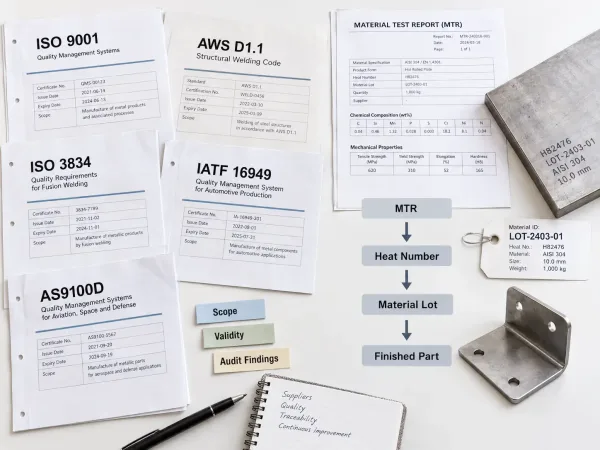
Supplier documentation should verify certification status and trace raw material to finished parts.
Material traceability failures are rare — until they are not. When a field failure triggers a root cause investigation, the absence of MTRs can turn a manageable quality event into a liability nightmare.
Review Point #5 — Process Capability and Equipment Health
A supplier’s equipment list at qualification time does not tell you what condition that equipment is in today. During the annual review, ask:
- What equipment has been added, replaced, or retired since the last review? New equipment may improve capability; retired equipment may eliminate a process you depend on.
- What is the maintenance schedule for critical equipment? Laser cutters, press brakes, and welding stations all have consumable components that degrade over time.
- Can the supplier still meet the manufacturing quality requirements specified on your drawings? If your parts require ±0.1 mm on laser-cut features, verify the supplier’s current equipment can achieve this consistently.
For sheet metal fabrication specifically, evaluate capability in these areas:
- Laser cutting: edge quality (dross-free cuts), dimensional repeatability, maximum sheet thickness capability.
- Bending: angle accuracy (typically ±0.5°), bend radius consistency across a batch.
- Welding: penetration consistency, spatter control, cosmetic quality for visible welds.
- Surface finishing: coating thickness uniformity, adhesion test results, color consistency.

Annual reviews should verify current cutting, bending, welding, and finishing capability.
Review Point #6 — Communication and Responsiveness
Communication quality is difficult to quantify but easy to feel. During the annual review, assess:
- RFQ turnaround time: How long does the supplier take to return a quote? A supplier that consistently responds in 24–48 hours values your business. One that takes two weeks may be overcommitted.
- Engineering change response: When you revise a drawing, how quickly does the supplier acknowledge the change, update their process, and confirm feasibility?
- Problem escalation: When the supplier discovers a non-conformance during production, do they notify you proactively, or do you find out during incoming inspection?
Poor communication is an early warning signal. Suppliers that become slow to respond or vague in their answers are often managing internal problems they have not disclosed.
Review Point #7 — Pricing Transparency and Cost Management
Price is important, but unit price alone does not tell you the full cost story. During the annual review, evaluate the manufacturing total price and cost structure, including:
- Price stability: Has the supplier raised prices during the year? If so, was the increase justified by documented material cost changes or process additions?
- Hidden costs: Are you seeing frequent charges for rework, expedite fees, or tooling adjustments that were not part of the original quote?
- Total cost of ownership (TCO): Factor in the cost of quality rejects, engineering time spent on clarifications, and any inventory buffer you carry to compensate for delivery variability.
A supplier with a slightly higher unit price but zero defects and consistent on-time delivery may be cheaper in total than a low-price supplier that generates rework and schedule disruptions.
Review Point #8 — Risk Assessment and Supply Continuity
The final review point looks beyond performance metrics to assess what could go wrong in the coming year.
- Single-source dependency: If this supplier is your only source for a critical part, what happens if their facility has a fire, a key machine breaks down, or they lose a major operator?
- Capacity headroom: Is the supplier running at near-full capacity? If so, a surge in your order volume — or their other customers’ volume — could push your lead times out.
- Financial health: For strategic suppliers, a periodic check of financial indicators (payment history, credit reports, ownership changes) is prudent.
- Geographic concentration: If multiple critical suppliers are in the same region, a single event (natural disaster, logistics disruption) can affect your entire supply chain.
Mitigation strategies include maintaining a qualified backup supplier for critical parts, holding safety stock, and negotiating capacity reservation agreements.
How to Score: Building a Weighted Evaluation Matrix
Recommended Weight Allocation
Not all review points carry equal importance. For most sheet metal procurement contexts, the following weight allocation works as a starting point:
| Review Point | Recommended Weight | Rationale |
|---|---|---|
| Quality Performance | 30% | Defects propagate through assembly and customer delivery |
| On-Time Delivery | 20% | Late parts disrupt production schedules |
| Process Capability | 15% | Capability determines whether the supplier can meet evolving requirements |
| Certifications & Compliance | 10% | Baseline requirement, not a differentiator among qualified suppliers |
| Material Traceability | 5% | Critical when needed, but most suppliers handle this adequately |
| Communication | 10% | Affects efficiency of daily operations |
| Pricing | 5% | Important but already evaluated at PO stage |
| Risk Assessment | 5% | Strategic, not operational — review annually but weight lightly in composite score |
Adjust weights based on your industry. Automotive buyers may increase quality and certification weights. Buyers in cost-sensitive markets may increase pricing weight.
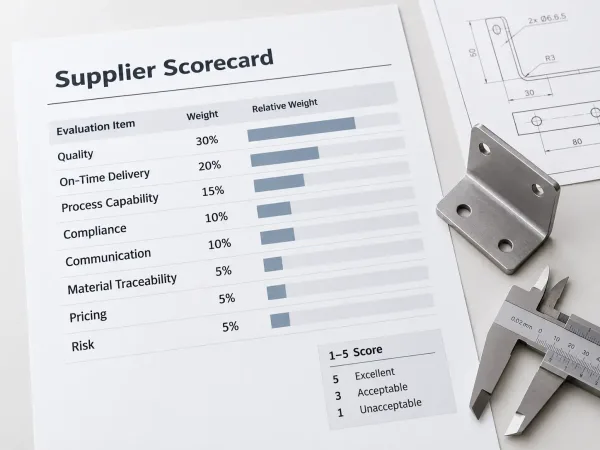
Example weighting for eight supplier performance criteria in an annual review.
The 1-to-5 Scoring Standard
Use a consistent 1–5 scale for each review point:
- 5 — Excellent: Exceeds expectations, no issues identified, trending upward.
- 4 — Good: Meets expectations with minor observations.
- 3 — Acceptable: Meets minimum requirements but has areas for improvement.
- 2 — Below expectations: Significant gaps identified; requires corrective action.
- 1 — Unacceptable: Fails to meet minimum requirements; escalation required.
Multiply each score by its weight to produce a weighted composite score. A supplier scoring 3.5 or above (weighted) is generally performing acceptably. Below 3.0 triggers a corrective action plan.
After the Review: From Findings to Action
Structuring the Supplier Feedback Conversation
Share the review results with the supplier in a structured format. The conversation should be factual, not confrontational. Present the data, highlight areas of concern, and ask the supplier for their perspective. In many cases, the supplier already knows where their performance has slipped — they just have not been asked about it directly.
CAPA Plans and KPI Targets for the Next Year
For each area scoring below expectations, agree on a Corrective and Preventive Action (CAPA) plan with specific deliverables, deadlines, and measurable KPI targets. For example: “Reduce weld defect rate from 2.1% to below 1.0% by Q2 through operator requalification and updated welding procedures.”
The Keep / Watch / Phase-Out Decision Framework
After scoring and CAPA discussion, classify each supplier into one of three categories:
- Keep: Composite score ≥ 3.5, no critical gaps. Continue ordering with confidence.
- Watch: Composite score 3.0–3.4, or a declining trend in any key area. Assign CAPA targets and schedule a mid-year check-in.
- Phase-out: Composite score < 3.0, or a critical failure in quality/compliance that the supplier cannot or will not address. Begin qualifying an alternative source.
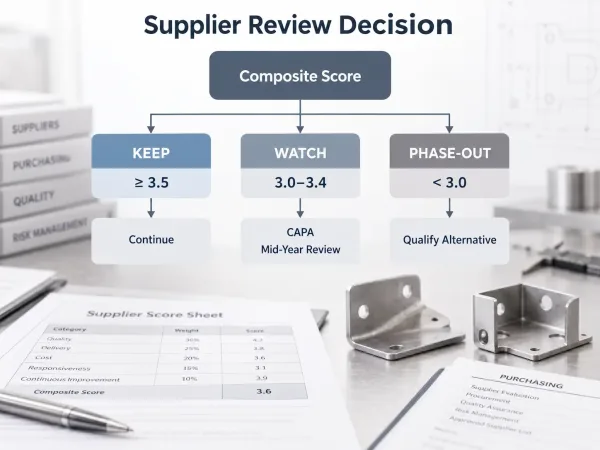
Supplier scores can be translated into Keep, Watch, or Phase-Out actions.
This classification is not punitive. It is a supply chain risk management tool that protects your production continuity.